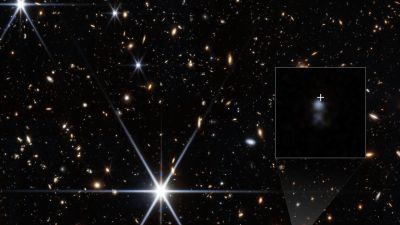
Euclid's Groundbreaking Discovery: Quasar J1504+6252 at Redshift 8.13
Euclid's infrared survey unveils quasar J1504+6252 at redshift 8.13, revealing insights into early black hole growth.
Category
Origin and structure of the cosmos.
Euclid's infrared survey unveils quasar J1504+6252 at redshift 8.13, revealing insights into early black hole growth.
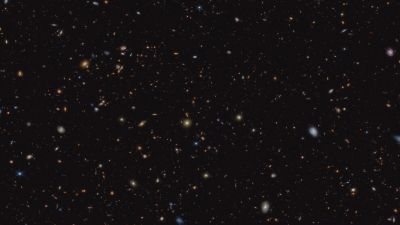
New research suggests dark energy's density may have switched from negative to positive, offering insights into the Hubble tension.
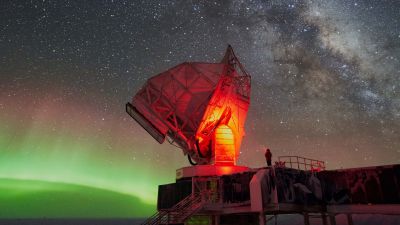
Explore how the SPT-3G camera and BICEP Array at the South Pole hunt for primordial gravitational waves in the cosmic microwave background,...
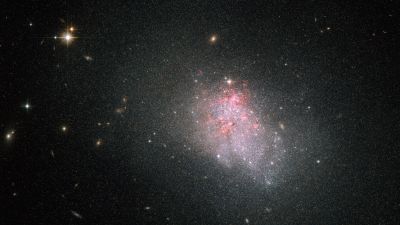
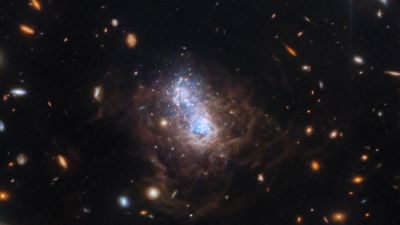
A recent study using Hubble spectroscopy finds that supernova-driven winds in starburst galaxies block rather than facilitate Lyman continuu...
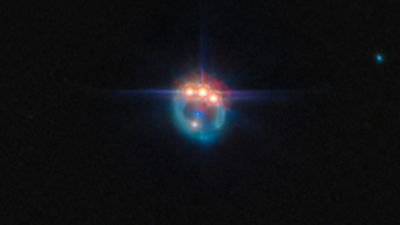
TDCOSMO 2026 uses 11 lensed quasars to measure H0 independently of the Cepheid distance ladder, highlighting a persistent tension with Planc...
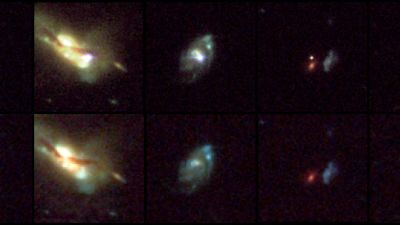
FRB 20240304B, detected by MeerKAT and pinpointed by JWST, challenges existing theories about fast radio bursts with its unexpected host gal...
The James Webb Space Telescope's observations reveal metal-enriched outflows in galaxies just 500 million years after the Big Bang, reshapin...
The LBT Yp Project has achieved a groundbreaking measurement of primordial helium abundance, refining our understanding of the early univers...
The LBT Yp Project's new measurement of primordial helium abundance offers critical insights into Big Bang nucleosynthesis, neutrino familie...
A recent clash in the Monthly Notices of the Royal Astronomical Society challenges the current understanding of cosmic acceleration using th...
MeerKAT has achieved a significant milestone by directly detecting the 21cm hydrogen signal on Mpc scales, providing insights into the unive...
A new JWST/NIRSpec study reveals that 'leaky' galaxies, with a high escape fraction of ionizing photons, played a crucial role in the reioni...
Google Preferred Sources
Choose Space Telescope as a preferred source to make our mission news, visual reporting, and independent explainers easier to find in Google Search.