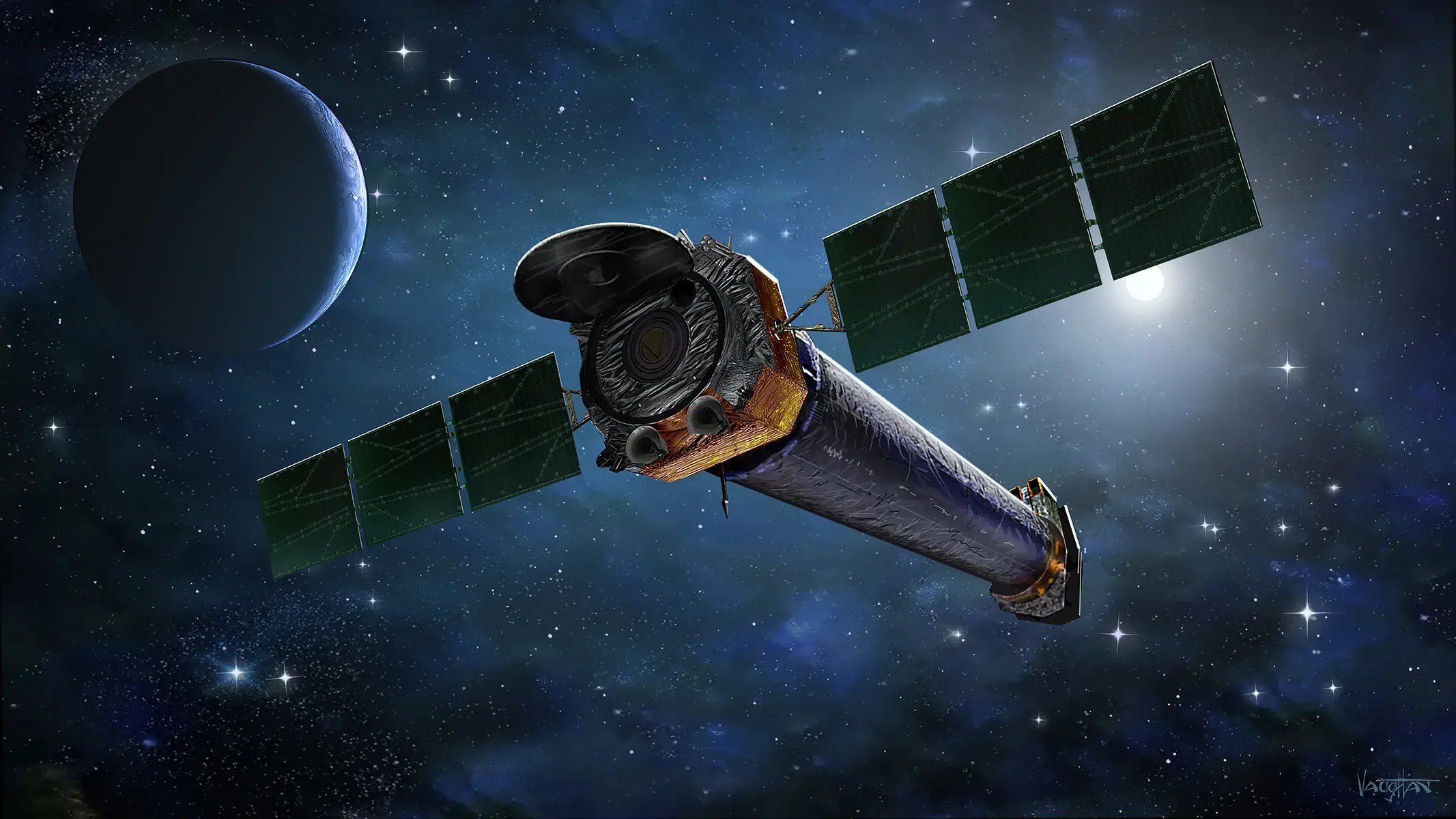
Chandra X-ray Observatory
The hot universe, resolved in X-rays.
Chandra reveals black holes, exploded stars, colliding galaxies, and superheated gas that remain hidden from telescopes tuned to visible and infrared light.
Mission artwork: NASA and Chandra X-ray Center · Official Chandra mission ↗
- Launched
- July 23, 1999
- Observes
- High-energy X-rays
- Angular resolution
- About 0.5 arcsecond
- Instrument systems
- 4 complementary sets
A different universe
Light from the most extreme places.
X-rays are produced where matter is heated to millions of degrees or accelerated by intense magnetic and gravitational fields. Earth’s atmosphere blocks those photons, so Chandra observes from space with exceptionally sharp X-ray vision.
Its long, highly elliptical orbit allows extended observing sessions above Earth’s radiation belts, giving astronomers time to resolve faint structures around compact objects, supernova remnants, and galaxy clusters.

Mission photostream
The high-energy universe in color.
Browse Chandra observations of black holes, stellar explosions, galaxy clusters, and energetic structures, presented alongside the science behind each image.


High-energy astrophysics
Where gravity, heat, and magnetic fields become visible.
Chandra detects energetic processes that other wavelengths can miss, then works with Webb, Hubble, and ground observatories to build a fuller physical picture.
Black holes
Trace hot matter near event horizons, energetic jets, and the influence of supermassive black holes on their host galaxies.
Stellar explosions
Map shock waves, chemical elements, and compact remnants left behind when massive stars end their lives.
The hot cosmic web
Measure the immense reservoirs of superheated gas that fill galaxy clusters and record the growth of cosmic structure.
The X-ray payload
Imaging and spectra for an energetic sky.
Chandra’s cameras and transmission gratings can locate X-ray sources, measure their energy, and separate their light into detailed spectra.
ACIS
Advanced CCD Imaging Spectrometer
Produces X-ray images while measuring the energy of incoming photons across extended and compact sources.
HRC
High Resolution Camera
Uses Chandra’s sharp mirrors to pinpoint sources and capture fine structure with excellent timing precision.
HETG
High Energy Transmission Grating
Disperses higher-energy X-rays into spectra that reveal temperature, motion, density, and chemical composition.
LETG
Low Energy Transmission Grating
Provides high-resolution spectroscopy at lower X-ray energies for stars, compact objects, and diffuse hot gas.
Mission arc
A flagship X-ray observatory still at work.
-
Columbia carries Chandra to space
Space Shuttle mission STS-93 deploys the observatory, which then enters its high elliptical orbit around Earth.
-
First light demonstrates sharp X-ray vision
Early observations resolve structures and sources with detail that establishes a new standard for X-ray astronomy.
-
A growing high-energy record
Long observations and coordinated campaigns expand knowledge of black holes, supernova remnants, stars, and galaxy clusters.
-
An active mission
Chandra continues observing the X-ray universe and adding new value to multiwavelength studies across the modern observatory fleet.
A universe beyond visible light
Explore what only X-ray vision can reveal.
Open the Chandra archive to see extreme objects, hot gas, and energetic events through more than two decades of observations.