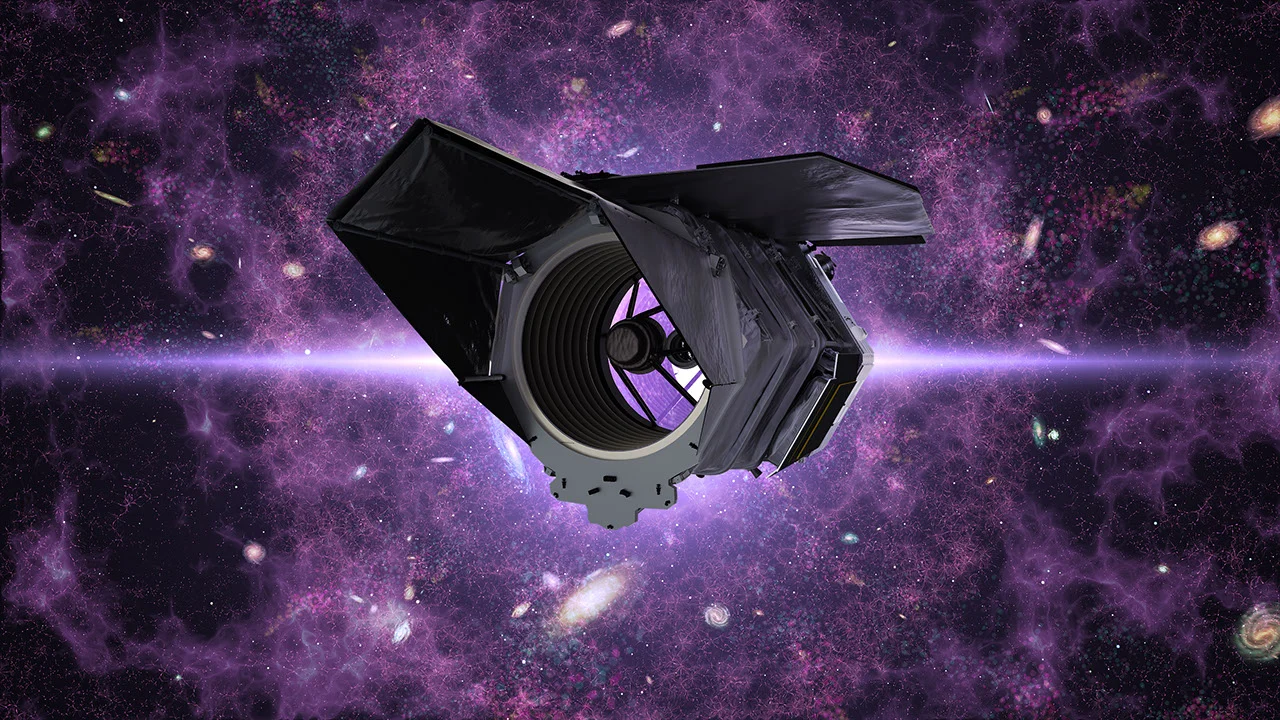
Nancy Grace Roman Space Telescope
A panoramic view of the universe is on its way.
Roman lifted off on 30 August 2026 and is now cruising toward Sun-Earth L2, unfolding and powering up its systems during a three-month commissioning. It pairs Hubble-class sharpness with a field of view at least 100 times larger.
Mission artwork: NASA · Official Roman mission ↗
- Mission clock
- Roman launched on August 30, 2026 at 7:26 a.m. Eastern Daylight Time and is cruising to Sun-Earth L2. Time since launch · updates live
- Trip to L2
- Flight day 44 of about 90 A million-mile cruise with commissioning under way
- Latest milestone
- Coronagraph powered on Sep 1, 2026 · 07:27 EDT
- Next up
- Wide Field Instrument power-on About two weeks after launch
A survey observatory
Sharp enough for detail. Wide enough for discovery.
Roman is designed to survey huge areas of the infrared sky without giving up the resolution astronomers expect from a flagship space telescope. That combination turns rare objects and slow cosmic change into measurable populations.
Its Wide Field Instrument will map galaxies and stars at scale, while the Coronagraph Instrument will demonstrate advanced techniques for suppressing starlight and studying nearby planetary systems.

Mission photostream
Roman, from clean room to first light.
Look back at the hardware, teams, tests, and launch campaign, then return in early 2027 for the observatory’s first wide-field views of the infrared universe.


A universe measured at scale
See the forest and the stars.
Roman is built for questions that become clearer when astronomers can study millions of objects with consistent, high-resolution observations.
Dark energy
Map galaxies and exploding stars across cosmic time to test how the universe expanded and how large-scale structure grew.
Exoplanet census
Use gravitational microlensing to reveal planets across the Milky Way, including worlds far from their host stars.
The changing sky
Repeated wide-field surveys will expose variable stars, distant supernovae, moving objects, and discoveries not yet anticipated.
The science payload
A wide camera and a new way to block a star.
Roman’s observatory pairs proven 2.4-meter optics with a wide survey instrument and a technology demonstration for direct exoplanet imaging.
WFI
Wide Field Instrument
A 300-megapixel infrared camera and spectroscopic system for wide, deep surveys of galaxies, stars, and planetary systems.
CGI
Coronagraph Instrument
A technology demonstration designed to suppress bright starlight and advance direct observation of faint nearby companions.
2.4 m
Primary mirror
A Hubble-sized mirror provides sharp space-based imaging while Roman’s focal plane captures a much wider scene.
L2
Stable observing environment
Roman is heading for a halo orbit around Sun-Earth L2, about 1.5 million kilometers from Earth, with a clear view of the sky and conditions suited to long survey programs.
Mission arc
From a decadal priority to a panoramic observatory.
-
A wide-field space survey becomes a priority
The US astronomy decadal survey recommends a flagship infrared mission for dark energy, exoplanets, and wide-field astrophysics.
-
The mission is named for Nancy Grace Roman
NASA honors its first chief astronomer, whose leadership helped establish the era of space-based astronomy.
-
The flight observatory comes together
Teams integrate the telescope, instruments, spacecraft, and deployable systems, then move into final environmental and launch testing.
-
Liftoff from Kennedy Space Center
Falcon Heavy lifted off from Launch Complex 39A at 7:26 a.m. EDT. Roman separated from the upper stage 31 minutes later, and its solar arrays and sunshield opened about an hour and 23 minutes after launch.
-
First course correction and antenna deployment
A roughly three-minute mid-course correction burn at 12:02 p.m. EDT refined the path to L2. That afternoon the 1.7-meter high-gain antenna unfolded, ready to return science data at up to 500 megabits per second.
-
Aperture cover opens and the coronagraph wakes
The deployable aperture cover, Roman’s sun visor, extended on three booms in about eight minutes. Just over an hour later the Coronagraph Instrument powered on to begin months of calibration.
-
Wide Field Instrument power-on
About two weeks into the flight, the 300-megapixel survey camera is switched on and starts its own commissioning checks.
-
Arrival at Sun-Earth L2
Roughly three months and a million miles after launch, Roman settles into its halo orbit around L2 and completes commissioning.
-
First images and survey operations
NASA expects to release Roman’s first images by early 2027 as the core community surveys begin, sending about 1.4 terabytes of data a day to a public archive.
Now in flight
Follow Roman from launch to first light.
Browse the latest mission imagery now and return as commissioning, first images, and Roman’s public science archive unfold.