Unveiling FRB 20240304B
Fast Radio Bursts (FRBs) have long intrigued astronomers with their mysterious origins and fleeting nature. The recent detection of FRB 20240304B has added a new layer to this cosmic puzzle. Detected by the MeerKAT radio telescope, this FRB is the most distant ever localized, with a redshift of 2.148. This places it approximately 3 billion years after the Big Bang, during the epoch known as 'cosmic noon'—a time when star formation in the universe was at its peak.
Pinpointing the Host Galaxy
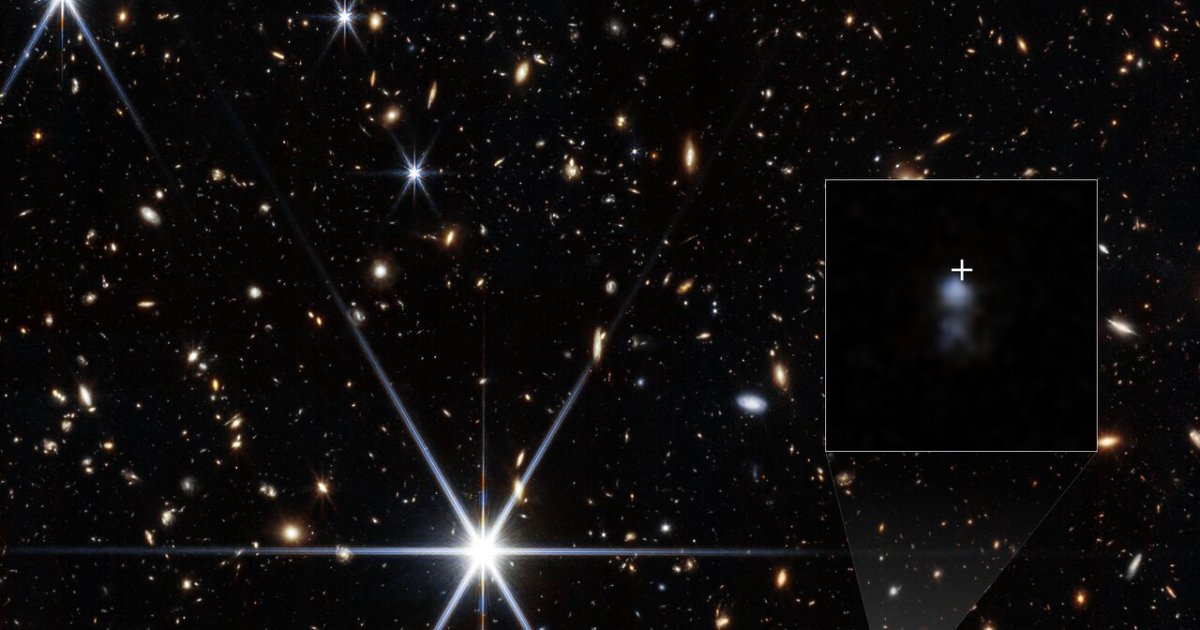
The James Webb Space Telescope (JWST), utilizing its Near Infrared Camera (NIRCam) and Near Infrared Spectrograph (NIRSpec), played a crucial role in identifying the host galaxy of FRB 20240304B. The host is a tiny, young, star-forming dwarf galaxy, significantly less massive than what scientists typically expect for such a powerful burst. This galaxy is roughly 1000 times less massive than the Milky Way, challenging existing models of FRB progenitors.
Implications for FRB Progenitors
The discovery of FRB 20240304B in such a diminutive galaxy has significant implications for understanding the origins of FRBs. Traditionally, neutron-star mergers have been considered a potential source of FRBs. However, the low mass and young age of the host galaxy make this scenario less likely. Neutron-star mergers are generally expected to occur in older, more massive galaxies where binary star systems have had time to evolve and coalesce.
Instead, the characteristics of the host galaxy favor a young magnetar as the progenitor of FRB 20240304B. Magnetars are highly magnetized neutron stars, and young magnetars, in particular, are thought to be capable of producing the energetic bursts observed in FRBs. The intense magnetic fields and rapid rotation of young magnetars could explain the powerful emissions detected from such a distant source.
Why a Young Magnetar?
The environment of the host galaxy supports the young magnetar hypothesis. The galaxy's active star formation suggests a population of massive stars that could end their lives as magnetars. The relatively low metallicity of the galaxy, a common trait in young star-forming regions, aligns with conditions favorable for the formation of magnetars. This environment contrasts with the older, more metal-rich galaxies where neutron-star mergers are more likely.
Challenges and Future Prospects
While the identification of FRB 20240304B's host galaxy provides compelling evidence for a young magnetar origin, it also raises questions about the diversity of FRB sources. The discovery suggests that FRBs might originate from a wider variety of environments than previously thought. Future observations with JWST and other telescopes will be crucial in exploring these possibilities further.
Additionally, the study of such distant FRBs offers a unique opportunity to probe the conditions of the early universe. By understanding the environments in which these bursts occur, scientists can gain insights into the processes of star formation and galaxy evolution during cosmic noon.
Conclusion
FRB 20240304B stands as a testament to the power of modern astronomy to unravel the mysteries of the universe. Its detection and localization challenge existing theories and open new avenues for research. As we continue to explore the cosmos, each discovery brings us closer to understanding the complex tapestry of the universe and our place within it.