The 1999 Archival Cold Case
In a fascinating twist of cosmic detective work, scientists have revisited archival data from the Hubble Space Telescope, uncovering new insights into the white dwarf HS 0209+0832. Originally collected in 1999, this data lay dormant until recent technological advances allowed astronomers to extract groundbreaking information. The spectral data revealed unusual chemical signatures, prompting researchers to take a closer look at this stellar remnant.
The Niobium Signature
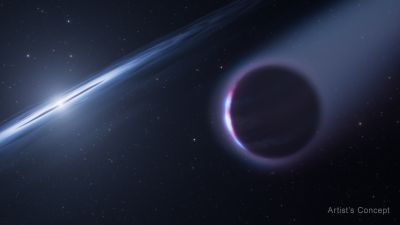
One of the most intriguing findings was the detection of niobium, a heavy element not commonly associated with white dwarfs. This rare element, along with other heavy metals, suggested the presence of a second-generation planet. Scientists estimate that this planet, roughly the size of Jupiter, is orbiting approximately 6 million kilometers from the white dwarf. The niobium signature was a crucial clue, indicating that the planet is losing its atmosphere, likely due to the intense gravitational pull of the white dwarf.
Corroboration by FUSE and TESS
The Far Ultraviolet Spectroscopic Explorer (FUSE) and the Transiting Exoplanet Survey Satellite (TESS) have played pivotal roles in corroborating these findings. FUSE provided additional spectral data, reinforcing the presence of heavy elements, while TESS's observations helped confirm the planet's orbital characteristics. These combined efforts have strengthened the case for a second-generation planet orbiting HS 0209+0832.
The Warwick-Led Nature Astronomy Result
A recent study led by researchers from the University of Warwick, published in Nature Astronomy, has further cemented these findings. The team used sophisticated modeling techniques to analyze the spectral data, concluding that the heavy-element abundance is consistent with a planet formed from the remnants of a dead star. This discovery opens up new avenues for understanding planet formation in extreme environments.
Implications of a Planet Born from a Dead Star's Ashes
The existence of a second-generation planet around HS 0209+0832 challenges traditional notions of planet formation. Typically, planets form from the protoplanetary disks surrounding young stars. However, in this case, the planet appears to have formed from the debris left behind after the star's death. This finding suggests that planetary systems can arise even in the aftermath of stellar destruction, offering a new perspective on the resilience and adaptability of planetary formation processes.
For more details on this fascinating discovery, visit the NASA Science page and the ESA Hubble site.