Unveiling the Intricacies of Pa 30
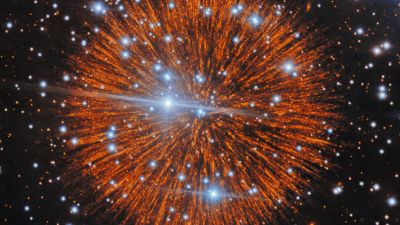
In a groundbreaking observation, the Gemini North telescope has captured new images of the supernova remnant Pa 30, associated with the historical supernova SN 1181. The data, collected using the Gemini Multi-Object Spectrograph (GMOS), reveal a strikingly detailed view of the remnant's structure, showing filamentary 'firework' rays composed of chains of pearl-like knots rather than smooth streaks. This discovery provides fresh insights into the nature of the rare Type Iax supernova that occurred nearly a millennium ago.
The Rare Type Iax Supernova
Supernova SN 1181, witnessed by Chinese, Japanese, and possibly Arabic astronomers in 1181 AD, is one of the few historical supernovae with surviving records. The recent observations of its remnant, Pa 30, offer a unique opportunity to study a Type Iax supernova, a rare subclass of stellar explosions. Unlike the more common Type Ia supernovae, which involve the complete disruption of a white dwarf, Type Iax events are less energetic and often leave behind a surviving 'zombie' star.
The Surviving 'Zombie' Star
At the heart of Pa 30 lies the 'zombie' star IRAS 00500+6713. This white dwarf remnant is characterized by extreme conditions, with surface temperatures reaching approximately 200,000 degrees Celsius and winds blowing at speeds of 16,000 kilometers per second. The near-perfect centering of this remnant within the supernova debris implies a symmetric, low-kick explosion, a feature that aligns with the characteristics of Type Iax supernovae.
Historical Records and Modern Discoveries
The supernova of 1181 AD was recorded by astronomers in China and Japan, and possibly in Arabic records, describing a 'guest star' that was visible for 185 days. These historical accounts have been crucial in identifying and studying Pa 30. The new images from Gemini North not only enhance our understanding of this ancient event but also demonstrate the power of modern telescopic technology in unraveling the complexities of cosmic phenomena.
Implications for Stellar Evolution
The detailed filamentary structure observed in Pa 30 suggests complex interactions between the ejected material and the surrounding interstellar medium. This intricate pattern of 'pearl-like' knots provides valuable clues about the dynamics and aftermath of Type Iax supernovae. Understanding these processes is essential for piecing together the life cycles of stars and the evolution of galaxies.
For further reading, explore the NOIRLab press release and the Harvard report on these findings.