Unveiling the Complex Structure of Pa 30
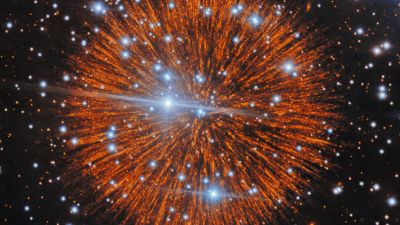
In a remarkable development, the Gemini North telescope's GMOS instrument has captured unprecedented images of Pa 30, the remnant of the supernova SN 1181. These observations, made in October 2026, reveal a complex web of filamentary structures that are approximately ten times more intricate than previously observed. Instead of smooth streaks, the 'firework' rays of the nebula are composed of chains of pearl-like knots, offering new insights into the explosion dynamics of this rare Type Iax supernova.
The Rare Type Iax Supernova
Type Iax supernovae are a rare subclass of supernovae, thought to result from the partial explosion of a white dwarf star. Unlike typical Type Ia supernovae, which completely destroy the progenitor star, Type Iax events leave behind a 'zombie' star. In the case of SN 1181, this surviving remnant is the star IRAS 00500+6713. Scientists estimate that this star has an astonishing surface temperature of around 200,000 degrees Celsius and emits winds traveling at speeds of 16,000 kilometers per second.
A Symmetric Explosion
One of the most intriguing aspects of the new observations is the near-perfect centering of the surviving star within the nebula. This suggests that the explosion was remarkably symmetric, imparting a low 'kick' to the remnant. Such symmetry is unusual for supernovae and provides valuable clues about the explosion mechanics of Type Iax events.
Historical Records of SN 1181
SN 1181 is one of the few historical supernovae with documented observations. It was recorded by Chinese, Japanese, and Arabic astronomers in 1181 CE, who noted its appearance as a bright 'guest star' in the sky. These records have been instrumental in confirming the identity of Pa 30 as the remnant of SN 1181. The historical accounts describe the supernova as visible for 185 days, a duration that aligns with the characteristics of a Type Iax explosion.
Implications for Stellar Evolution
The detailed structure of Pa 30, as revealed by Gemini North, provides a unique opportunity to study the aftermath of a Type Iax supernova. The pearl-like knots and filamentary structures offer insights into the distribution of ejected material and the physical processes at play during the explosion. Understanding these details can help astronomers refine models of stellar evolution and the life cycles of white dwarfs.
For more information on these findings, you can visit the NOIRLab and Harvard-Smithsonian Center for Astrophysics websites.