Unveiling the Universe: Hubble's 2026 Gravitational Lens Discovery
On October 22, 2026, NASA released a remarkable Hubble Space Telescope image of a gravitational lens known as DESI J194.5345+03.5358. This celestial phenomenon involves a foreground elliptical galaxy, situated approximately 4.5 billion light-years away, bending the light from a more distant background galaxy, located about 8 billion light-years away. The result is a stunning visual display: a bright arc and a smaller, flipped counter-arc of light, both of which provide critical insights into the distribution of dark matter within the lensing galaxy.
Gravitational lensing occurs when the gravitational field of a massive object, like a galaxy, warps the fabric of space-time, bending the light from objects behind it. This effect, predicted by Einstein's theory of general relativity, allows astronomers to study otherwise invisible aspects of the universe, such as dark matter, which does not emit or absorb light but exerts gravitational forces.
Weighing Dark Matter with Gravitational Lensing
The Hubble image of DESI J194.5345+03.5358 is not just a visual spectacle; it is a scientific treasure trove. By analyzing the distorted light arcs, astronomers can infer the mass distribution of the foreground galaxy, including its dark matter component. This method of 'weighing' galaxies provides crucial data for understanding the role of dark matter in galaxy formation and evolution.
Dark matter remains one of the most enigmatic components of the universe. While it constitutes about 27% of the universe's mass-energy content, its nature is still largely unknown. Gravitational lensing offers a unique tool for probing this mysterious substance, as it allows scientists to map the invisible mass that influences the bending of light.
What Else Is in the Frame
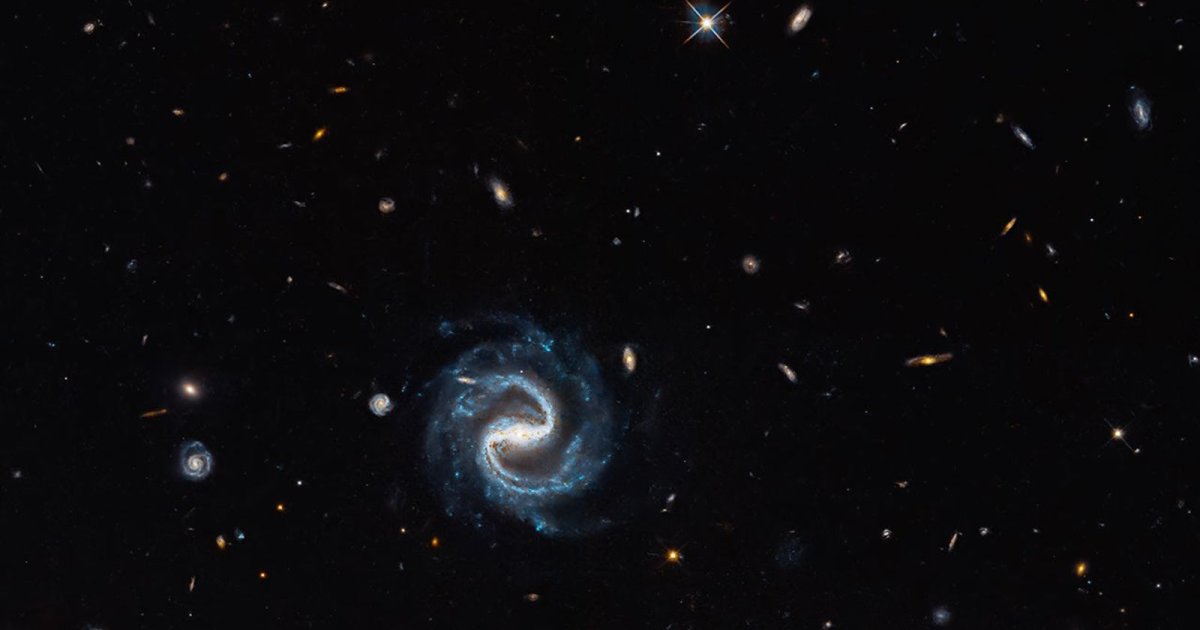
The lens is not the only thing worth a second look in Hubble’s view. Alongside the elliptical galaxy and its stretched arcs, the field contains a barred spiral galaxy roughly the size of the Milky Way, plus a much smaller spiral that may be one of its satellites, comparable to the Large and Small Magellanic Clouds that orbit our own galaxy. The imaging is credited to X. Huang of the University of San Francisco, working with NASA and ESA, with processing by Gladys Kober of NASA and the Catholic University of America.
The geometry itself is the measurement. The large arc to the upper left and the smaller, mirror-flipped image to the lower right are two views of the same background galaxy, split and stretched by the mass sitting in front of it. How far that light is displaced depends on how much mass the elliptical galaxy holds, and its visible stars alone cannot account for the distortion that Hubble records. The gap between what can be seen and what the arcs demand is precisely where dark matter is weighed.
Hubble, though, can only study these lenses one at a time. That is the constraint Roman was built to remove.
Training for the Roman Space Telescope's Wide-Field Survey
The Hubble Space Telescope's observations of gravitational lenses like DESI J194.5345+03.5358 are paving the way for future missions, particularly the Nancy Grace Roman Space Telescope. Now in orbit at the Sun-Earth L2 point and entering its science commissioning phase, the Roman Space Telescope will conduct a wide-field survey of the universe, with a keen focus on gravitational lensing phenomena.
Hubble's detailed images serve as a training ground for the Roman Space Telescope's advanced instruments. By analyzing Hubble's high-resolution data, scientists can refine algorithms and models that will be used to process the vast amounts of data expected from Roman's wide-field surveys. This preparatory work is essential for maximizing the scientific return of the Roman mission.
The Roman Space Telescope will feature a field of view 100 times larger than Hubble's, allowing it to capture more gravitational lenses across a broader area of the sky. This capability will enable astronomers to conduct statistical studies of dark matter and galaxy evolution on an unprecedented scale.
The Hubble-Roman Handoff: A Collaborative Effort
The transition from Hubble to Roman represents a significant step forward in our understanding of the universe. While Hubble has provided detailed observations of individual lenses, Roman will expand this work by surveying thousands of lenses, offering a more comprehensive view of the cosmos.
This collaboration between telescopes exemplifies the synergy between past and future missions. Hubble's legacy of high-resolution imaging and Roman's innovative wide-field capabilities together promise to unlock new secrets of the universe, particularly in the realm of dark matter research.
For more information on the Roman Space Telescope's mission and objectives, you can visit NASA's official page on the project. Additionally, NASA's Hubble mission page provides insights into how current observations are informing future explorations.