Introduction to NGC 1827
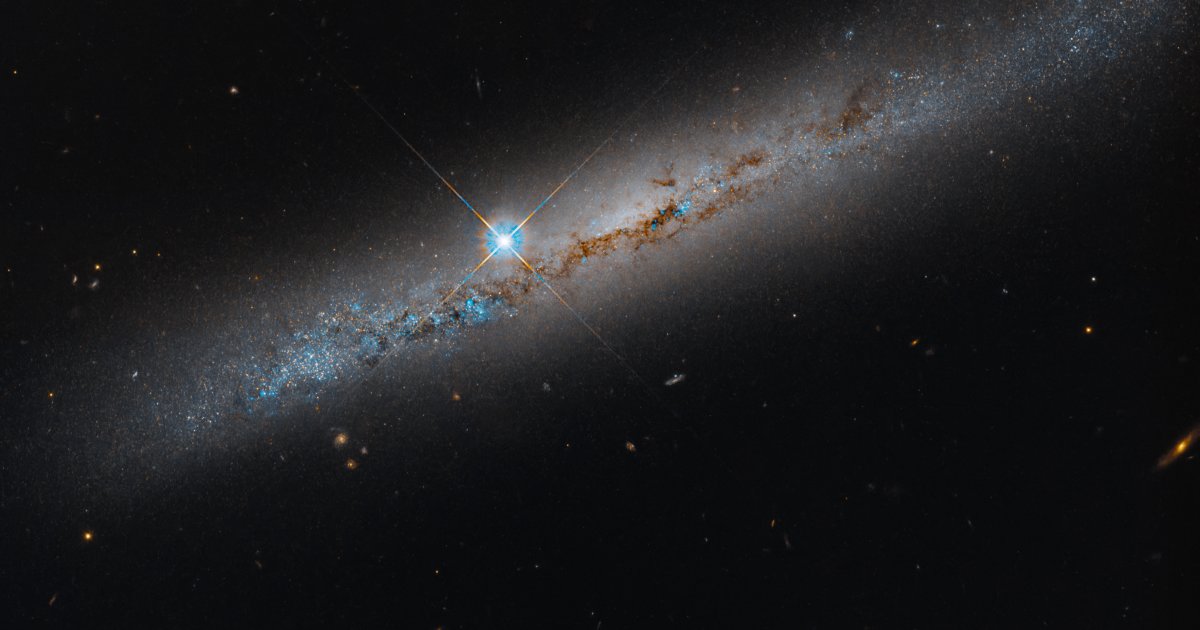
Located approximately 37 million light-years away in the constellation Columba, NGC 1827 is an edge-on intermediate spiral galaxy that has captivated astronomers with its striking features. Recently imaged by NASA's Hubble Space Telescope using the Advanced Camera for Surveys, this galaxy offers a unique opportunity to study its intricate structure and star-forming regions. The image released on October 16, 2026, provides a detailed view of NGC 1827's dust lanes, blue star-forming regions, and the diffraction spikes of a foreground star.
Dust Lanes and Star-Forming Regions
NGC 1827's edge-on orientation allows astronomers to observe its dust lanes in remarkable detail. These dark, sinuous bands are composed of interstellar dust and gas, which absorb and scatter light, creating a stark contrast against the brighter regions of the galaxy. These dust lanes are crucial for understanding the dynamics and evolution of spiral galaxies, as they are often sites of star formation.
Embedded within these dust lanes are regions of intense star formation, highlighted by the presence of young, hot, blue stars. These star-forming regions are essential for studying the life cycles of stars and the processes that govern galaxy evolution. The blue hue of these regions is indicative of the high temperatures of newly formed stars, which emit significant amounts of ultraviolet light.
Foreground Star and Diffraction Spikes
In the foreground of NGC 1827, a bright star creates prominent diffraction spikes, a common artifact in Hubble images. These spikes are caused by the light of the star interacting with the telescope's support structure, creating a cross-like pattern. While these spikes are not part of the galaxy itself, they add an aesthetic element to the image and serve as a reminder of the complex interplay between astronomical objects and the instruments used to observe them.
Hubble's Survey of Satellite Galaxies
The Hubble Space Telescope's survey of 260 satellite galaxies around 22 Milky Way-like hosts, including 111 observed galaxies, aims to test cosmological models on small scales. This survey is crucial for understanding the distribution and behavior of satellite galaxies, which are smaller galaxies gravitationally bound to larger ones. By studying these systems, scientists estimate they can refine models of galaxy formation and evolution.
NGC 1827, as part of this extensive survey, provides valuable data on the interactions between spiral galaxies and their satellites. Observations of such systems help astronomers test theories about dark matter and the role it plays in shaping the structure of the universe.
Conclusion
The Hubble Space Telescope's observations of NGC 1827 offer a window into the complex and dynamic processes that govern spiral galaxies. From its intricate dust lanes and star-forming regions to the foreground star's diffraction spikes, NGC 1827 serves as a fascinating subject for astronomers and space enthusiasts alike. As part of a broader survey, it contributes to our understanding of galaxy formation and the fundamental principles of cosmology.
For more information on Hubble's discoveries, visit NASA's Hubble Mission page and Sci.News.