Amateur Observers Spot a New Phenomenon
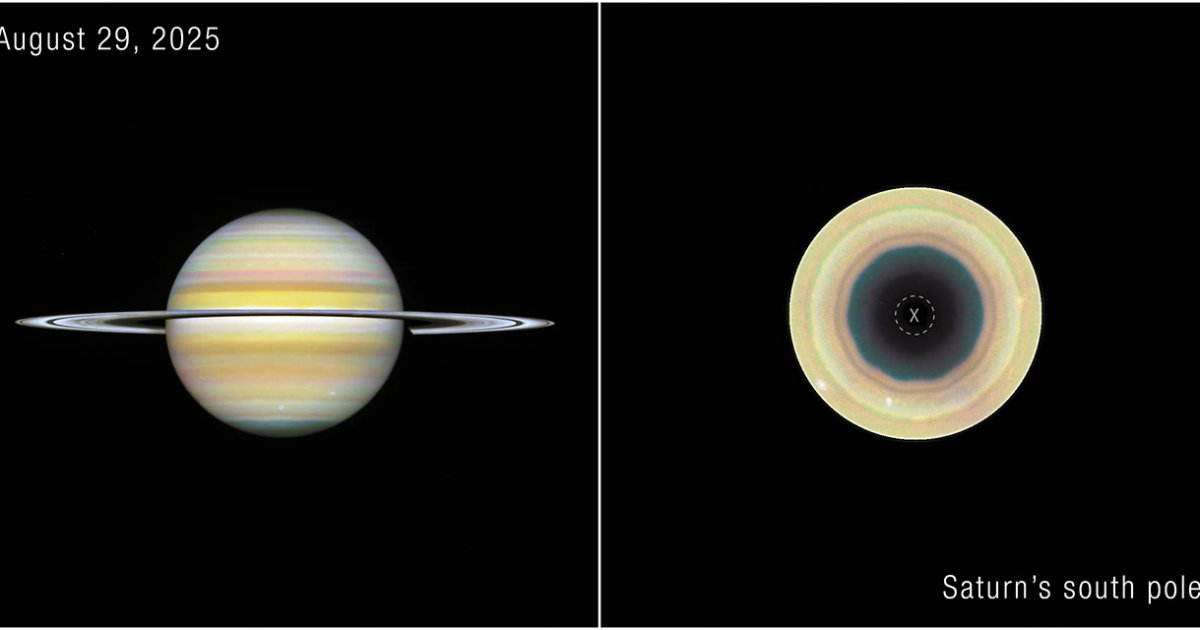
In 2024, amateur astronomers made an intriguing discovery: a peculiar geometric pattern encircling Saturn's south pole. This feature, which appeared to be a 10-sided wave, or 'decagon,' caught the attention of the astronomical community. The initial observations were made using backyard telescopes, and the news quickly spread through online forums and social media, sparking interest among professional astronomers.
Hubble's OPAL Program Confirms the Decagon
Following these amateur reports, NASA's Hubble Space Telescope, through its Outer Planet Atmospheres Legacy (OPAL) program, was tasked with investigating this unusual feature. Hubble's observations confirmed the presence of the decagon, tracing it back to 2023. The OPAL program, designed to monitor atmospheric changes in the outer planets, provided detailed images that revealed the structure's complexity and persistence over time. According to NASA, the decagon is a striking atmospheric phenomenon that extends vertically through multiple atmospheric layers.
Comparing the Decagon to Saturn's Northern Hexagon
Saturn is no stranger to geometric atmospheric patterns. Its northern hemisphere is home to a long-lived hexagon, a six-sided jet stream first discovered by the Voyager spacecraft in the early 1980s. However, the newly discovered decagon differs in several key aspects. While the northern hexagon is a well-defined, stable structure, the southern decagon appears more dynamic and less stable, with scientists estimating that it may be influenced by different atmospheric processes.
The European Space Agency (ESA) notes that the decagon's formation could be linked to seasonal changes as Saturn's southern hemisphere transitions through its lengthy year, which lasts about 29 Earth years. The decagon's appearance might be a temporary feature, emerging due to shifts in atmospheric temperature and pressure patterns.
Understanding the Vertical Structure
The decagon's vertical extension through multiple atmospheric layers is particularly intriguing. This suggests that the forces driving its formation are not confined to Saturn's surface but involve deeper atmospheric dynamics. The decagon's verticality implies that it may interact with other atmospheric phenomena, potentially influencing weather patterns across the planet's southern hemisphere.
Why Now? Theories Behind the Decagon's Formation
Scientists are still working to understand why the decagon has formed at this particular time. One theory suggests that changes in solar radiation reaching Saturn's southern hemisphere may be altering atmospheric conditions, creating the right environment for such a structure to emerge. Another possibility is that internal heat from Saturn's core could be affecting atmospheric dynamics, contributing to the decagon's development.
Research published in Science Advances indicates that further observations and modeling are necessary to fully understand the mechanisms behind this phenomenon. As Saturn continues its journey around the Sun, scientists will be watching closely to see how the decagon evolves.