Transforming Cosmic Data into Sound
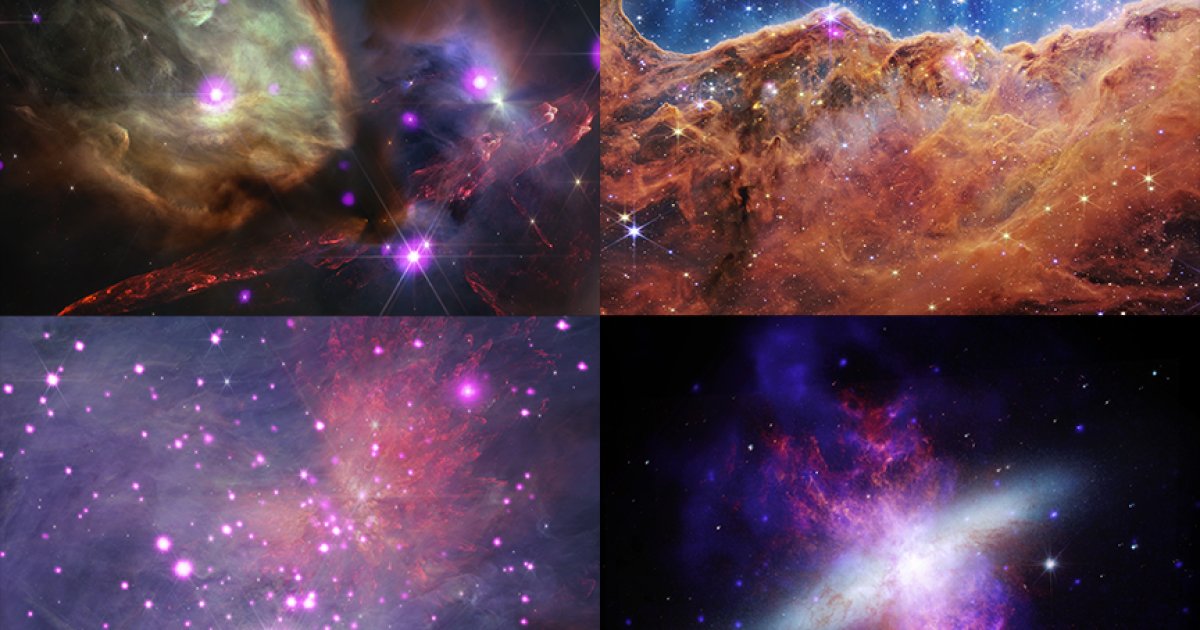
NASA's Chandra X-ray Observatory has unveiled a captivating new sonification album, released on November 17, 2026. This album transforms data from four star-forming regions into sound: the starburst galaxy M82, the Orion Nebula, Carina's 'Cosmic Cliffs,' and Rho Ophiuchi. By converting astronomical data into audio, scientists provide a unique way to experience the cosmos beyond visual observation.
The Science of Sonification
Sonification is the process of converting data into sound. In the context of Chandra's observations, this involves translating X-ray data into audio frequencies that humans can hear. Each piece of data, such as the intensity and energy of X-rays, is assigned a specific sound. For instance, higher energy X-rays might be represented by higher-pitched sounds, while lower energy X-rays could correspond to lower pitches. This method allows scientists and the public alike to 'hear' the universe, offering a new dimension to understanding astronomical phenomena.
Insights from Chandra's X-ray Observations
Chandra's X-ray observations are crucial for studying the energetic processes in star-forming regions. In the starburst galaxy M82, for example, Chandra's data reveals intense winds and outbursts from young and massive stars. These stellar winds can influence the formation of new stars by compressing surrounding gas and dust, a process that can be audibly represented in the sonification.
In the Orion Nebula, Chandra's X-rays uncover the dynamic interactions between young stars and their environment. The X-ray data highlights how these stars emit powerful winds that shape the surrounding nebula, a phenomenon now accessible through sound. Similarly, in Carina's 'Cosmic Cliffs,' the sonification captures the tumultuous activity of massive stars sculpting the nebula's intricate structures.
Combining Data from Multiple Observatories
This sonification project is not limited to Chandra's data alone. It integrates observations from other powerful telescopes, including the James Webb Space Telescope (JWST), the Hubble Space Telescope, and the Imaging X-ray Polarimetry Explorer (IXPE). Each observatory contributes unique data across different wavelengths, from X-rays to infrared, providing a comprehensive view of these star-forming regions.
JWST, for example, contributes detailed infrared observations that complement Chandra's X-ray data by revealing the cooler gas and dust threaded through these regions; its infrared imagery underpins the Orion Nebula, Cosmic Cliffs and Rho Ophiuchi composites. Hubble supplies optical data for M82 and Rho Ophiuchi, while NASA's Imaging X-ray Polarimetry Explorer (IXPE) adds a second X-ray view of Rho Ophiuchi alongside Chandra's. Infrared data from NASA's Spitzer Space Telescope rounds out the M82 composite.
By combining these datasets, the sonification album offers a multi-sensory exploration of the cosmos, allowing listeners to appreciate the complexity and beauty of star formation in a novel way.
Four Regions, From 390 Light-Years to 12 Million
The four objects span an enormous range of distance and scale. Rho Ophiuchi, a star-forming cloud in the constellation Ophiuchus filled with gas and stars of different sizes and ages, lies about 390 light-years from Earth and is the closest of the set. The Orion Nebula, one of the nearest and busiest stellar nurseries, sits roughly 1,310 light-years away. The 'Cosmic Cliffs' are a portion of the Carina Nebula about 7,670 light-years distant. M82, in Ursa Major, is by far the most remote at roughly 12 million light-years, and forms stars at a far higher rate than a typical galaxy such as our own Milky Way.
All four X-ray datasets were gathered with Chandra's ACIS instrument, in several cases over many years. The M82 image draws on 22 pointings taken between September 1999 and February 2014, totalling more than 272 hours of observing time, while the Rho Ophiuchi data comes from ten observations made between March and July 2022. The Orion Nebula view combines six pointings from January 2003, and the Cosmic Cliffs data came from a single 19-hour observation in October 2012.
Experience the Universe Through Sound
NASA's new sonification album is a testament to the innovative ways in which scientists are making space more accessible and engaging. By transforming complex data into sound, the project not only aids scientific understanding but also invites the public to experience the universe in an entirely new way. You can explore these sonifications and learn more about the project on Chandra's official website.