Introduction to the Discovery
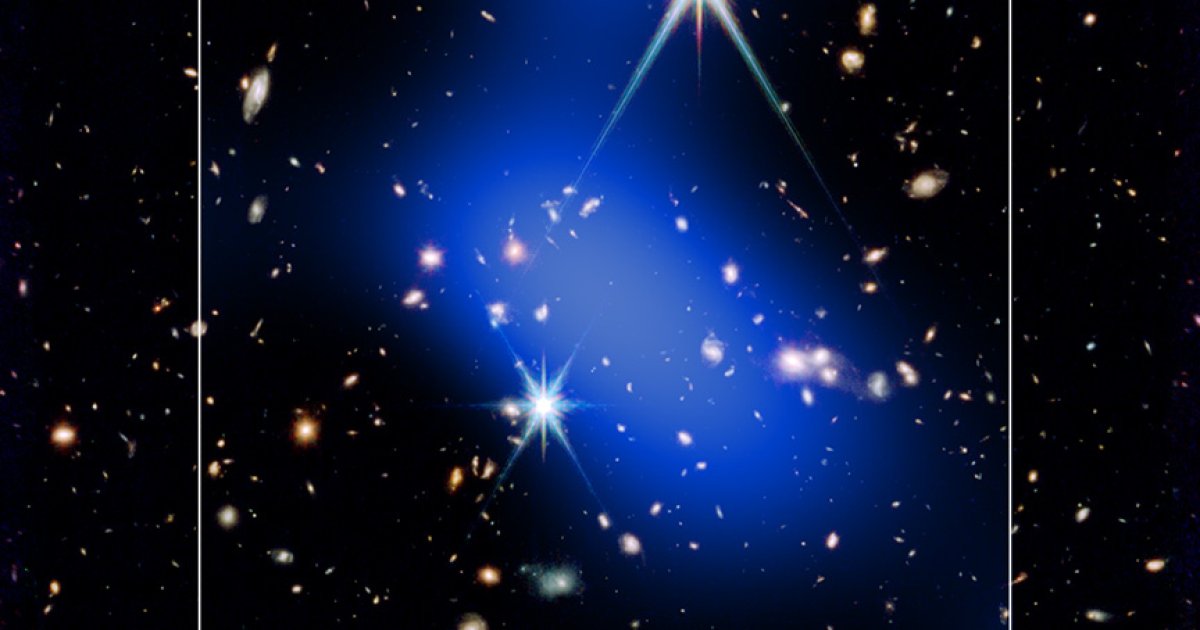
The Chandra X-ray Observatory has made a groundbreaking discovery, detecting thermal X-ray emissions from a proto-intracluster medium (proto-ICM) surrounding quasar ID1, a protocluster located at a redshift of z=3.25. This significant finding, published by Travascio et al. in Astronomy & Astrophysics in July 2026, sheds light on the early stages of galaxy cluster formation and the mechanisms by which these massive structures first heat up.
Details of the Observation
Chandra's observation, which lasted an impressive 634,000 seconds, revealed that the gas surrounding quasar ID1 is at an extremely high temperature of approximately 21 million Kelvin. This hot gas extends across a vast region of about 98,000 light-years. The mass of this gas is estimated to be around 2.6 trillion solar masses, constituting about 56% of the expected baryonic matter content, similar to what is observed in mature galaxy clusters.
Significance of the Thermal X-ray Emission
The detection of thermal X-ray emissions from the proto-ICM is a crucial step in understanding how galaxy clusters evolve. Typically, the intracluster medium (ICM) in mature clusters is known to be hot due to the gravitational energy released during the cluster's formation. However, this observation of a proto-ICM indicates that the heating process begins much earlier than previously thought, possibly during the initial stages of cluster formation when the protocluster is still forming.
Implications for Galaxy Cluster Formation
This discovery provides new insights into the processes that lead to the heating of the ICM. Scientists estimate that the energy required to heat the gas to such high temperatures could be due to several factors, including gravitational collapse, feedback from active galactic nuclei (AGN), or shock waves from merging substructures within the protocluster.
The fact that the proto-ICM around quasar ID1 holds a significant fraction of the expected baryonic matter suggests that the processes governing baryon retention and heating are already in place at this early stage. This challenges previous models that assumed a slower evolution of the ICM's thermal properties.
Future Research Directions
The findings from Chandra's observation open new avenues for research into the early universe and galaxy cluster evolution. Future studies will likely focus on identifying additional protoclusters with similar characteristics to understand the diversity of heating mechanisms and the timeline of ICM development. Moreover, combining X-ray data with observations from other wavelengths, such as radio and optical, can provide a more comprehensive picture of the processes at play.
Conclusion
The detection of thermal X-ray emissions from the proto-ICM around quasar ID1 marks a significant advancement in our understanding of galaxy cluster formation. By revealing that the heating of the ICM begins earlier than previously believed, this discovery challenges existing models and highlights the complex interplay of forces shaping the universe's largest structures. As researchers continue to explore the cosmos, findings like these will be instrumental in unraveling the mysteries of the early universe.