Webb image archive
How To Measure What Can’t Be Seen
Although black holes themselves can’t be seen, astronomers can employ several techniques to infer their masses from nearby stars, gas, and light. For black holes at closer di...
- Date
- Oct 9, 2026
- Observatory
- James Webb Space Telescope
- Credit
- NASA / ESA / CSA / STScI
- Archive ID
- how-to-measure-what-cant-be-seen
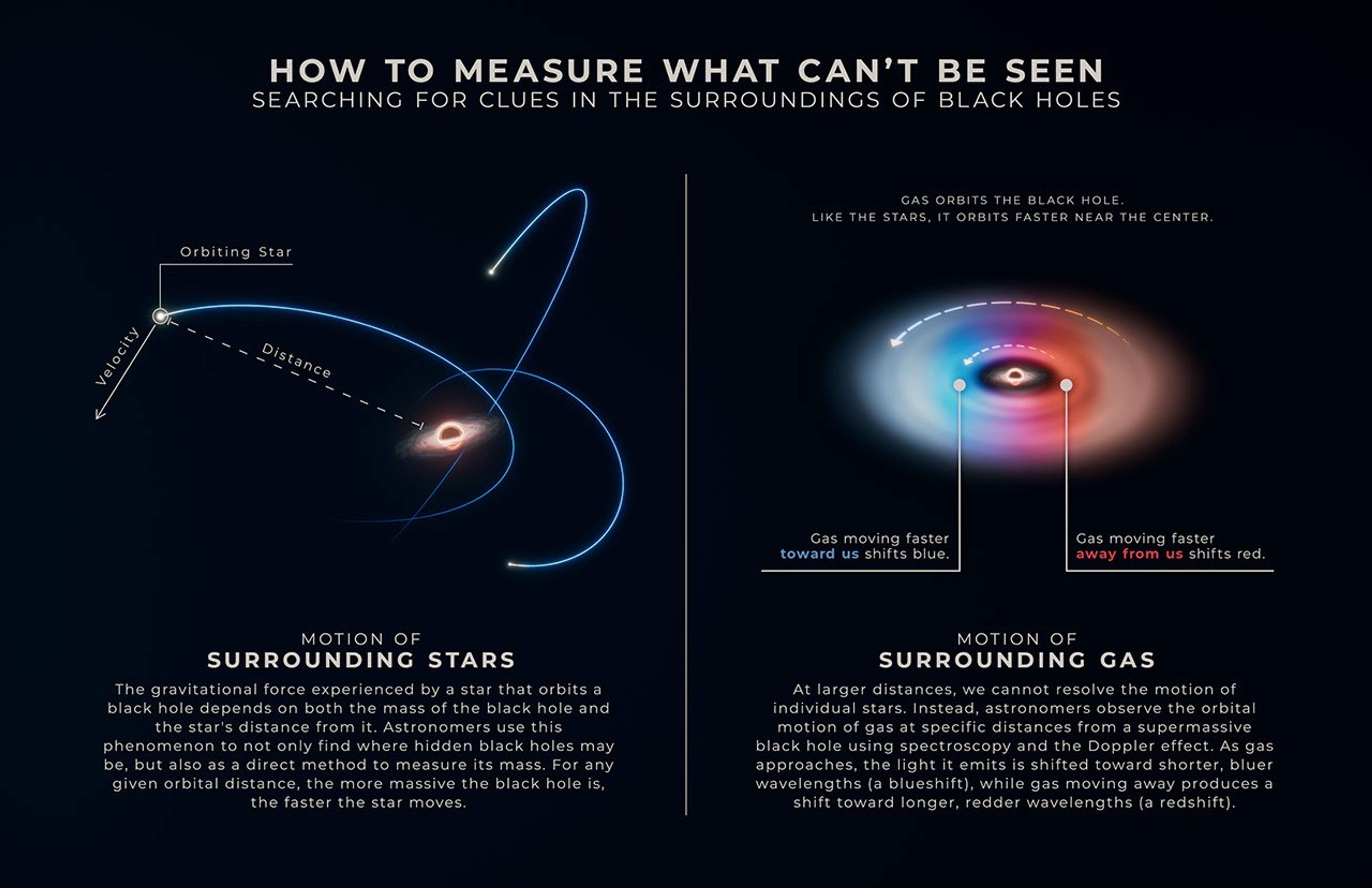
Although black holes themselves can’t be seen, astronomers can employ several techniques to infer their masses from nearby stars, gas, and light.
For black holes at closer distances, astronomers observe the motion of stars around black holes. The velocities of these stars allow us to calculate a black hole’s mass in the same way we measure the masses of planets by watching the orbits of their moons.
For black holes further away, astronomers utilize spectroscopy to study the motion of gases surrounding black holes. As gas moves toward us, light shifts toward shorter, bluer wavelengths, which is known as a blueshift. On the other hand, gas that moves away from us emits light that shifts toward longer, redder wavelengths, known as a redshift. Gas closer to the black hole moves faster, intensifying these effects.
Extended Description and Image Alt Text
Extended Description
Infographic titled “How to Measure What Can’t Be Seen, Searching for Clues in the Surroundings of Black Holes.” There are two columns, one to the left labeled “Motion of Surrounding Stars” and the other to the right labeled “Motion of Surrounding Gas.”
Left Column
The left column shows an illustration of a black hole, a black sphere surrounded by glowing white dust and gas, orbited by three white stars at different distances. Blue lines, which all curve around the black hole, extend from the stars illustrating the paths of their different orbits. One of the stars is labeled “Orbiting Star,” its distance from the black hole is represented by a dotted white line labeled “Distance,” and the direction of its movement is given by a white arrow that points to the bottom left of the infographic labeled “Velocity.” In this section, text reads, “The gravitational force experienced by a star that orbits a black hole depends on both the mass of the black hole and the star’s distance from it. Astronomers use this phenomenon to not only find where hidden black holes may be, but also as a direct method to measure its mass. For any given orbital distance, the more massive the black hole is, the faster the star moves.”
Right Column
The right column shows an illustration of a black hole similar to that in the left column that is surrounded by circular disk of gas. This disk has two shades. From 12 o’clock to 6 o’clock, the gas is red. The gas is a deeper red closer to the black hole and a paler red further away. The deeper red section is captioned, “Gas moving faster away from us shifts red.” From 6 o’clock to 12 o’clock, the gas is blue. The gas is a deeper blue closer to the black hole and a paler blue further away. The deeper blue section is captioned, “Gas moving faster toward us shifts blue.” Two dotted arrows trace the disk in a counterclockwise direction, one near the black hole and one along the edge of the disk. Text above this illustration reads, “Gas orbits the black hole like the stars, it orbits faster near the center.” Below the illustration, text reads, “At larger distances, we cannot resolve the motion of individual stars. Instead, astronomers observe the orbital motion of gas at specific distances from a supermassive black hole using spectroscopy and the Doppler effect. As gas approaches, the light it emits is shifted toward shorter, bluer wavelengths (a blueshift), while gas moving away produces a shift toward longer, redder wavelengths (a redshift).”
Image Alt Text
Infographic titled “How to Measure What Can’t Be Seen, Searching for Clues in the Surroundings of Black Holes.” There are two columns, one to the left labeled “Motion of Surrounding Stars” and the other to the right labeled “Motion of Surrounding Gas,” which detail different ways black hole mass can be measured.