Unveiling the Dusty Secrets of Cassiopeia A
The James Webb Space Telescope (JWST), with its Mid-Infrared Instrument (MIRI), has provided an unprecedented view of the supernova remnant Cassiopeia A (Cas A). This recent study, led by Temim et al. and published in the Astrophysical Journal Letters, highlights the intricate details of dust composition within the remnant, offering new insights into the processes that occur in the final moments of a star's life.
Mapping the Dust: Silica and Carbon Clumps
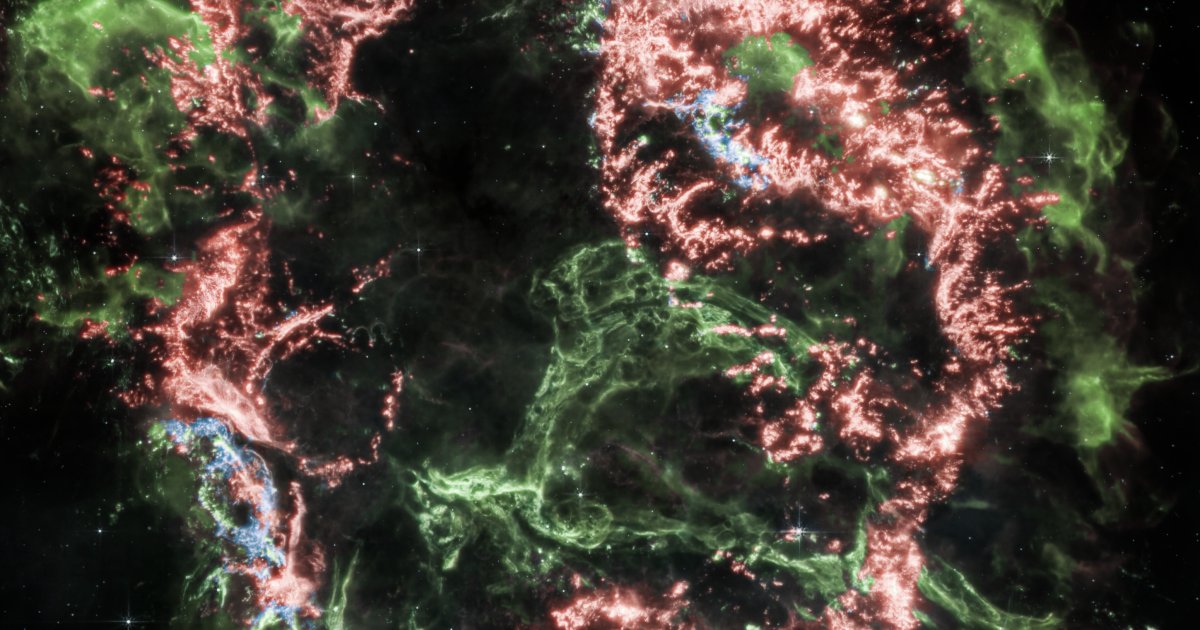
One of the most significant findings from the JWST's observations is the resolution of solar-system-sized clumps of ejecta within Cas A. These clumps, identified as distinct regions of dust, are primarily composed of silica and carbon. The silica-rich clumps suggest that silicon, a common element in the universe, plays a crucial role in the dust formation processes following a supernova explosion. On the other hand, the carbon-dominated clumps indicate that carbon, another fundamental building block of cosmic dust, is also prevalent in these environments.
The ability to distinguish between these different types of dust is a testament to the JWST's advanced capabilities. By resolving these clumps, scientists can better understand the chemical processes that occur during and after a supernova explosion, which in turn sheds light on the lifecycle of stars and the formation of planets and other celestial bodies.
The 'Green Monster' and Magnesium Silicates
Another intriguing feature observed by the JWST is the pre-explosion 'Green Monster,' a region rich in magnesium silicates. Unlike the silica- and carbon-rich ejecta clumps, this material was shed by the star before it exploded, and it was first identified as a distinct structure by Webb. Taken together, the grain compositions Webb mapped across the remnant point to a shell merger inside the progenitor star, in which neighbouring burning layers mixed possibly just hours before core collapse. Such mergers can dramatically alter the star's structure and the chemical abundances released by the explosion.
Magnesium silicates are important components in the study of cosmic dust, condensing readily in the cooling gas around dying stars. The presence of these silicates in the 'Green Monster' region provides valuable clues about the conditions leading up to and immediately following the supernova event.
Implications for Stellar Evolution
The discoveries made by JWST in Cas A have far-reaching implications for our understanding of stellar evolution. By analyzing the composition and distribution of dust in this supernova remnant, scientists can infer the processes that occur in the late stages of a star's life. The evidence of a shell merger, for instance, suggests that such events might be more common than previously thought, potentially affecting the dynamics of the supernova explosion and the resulting distribution of elements in the universe.
These findings also underscore the importance of studying supernova remnants as laboratories for understanding the complex interplay of physical processes that govern the lifecycle of stars. As scientists continue to analyze the data from JWST, we can expect to gain even deeper insights into the nature of these cosmic phenomena.
For more detailed information on this study, you can refer to the NASA's official release and the Phys.org article.