A dark-energy telescope finds a comet
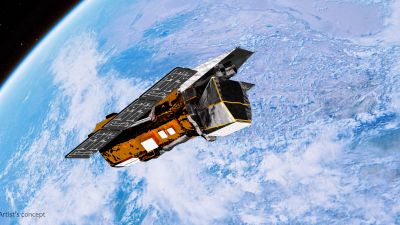
ESA launched Euclid in 2023 with a single overriding goal: to map billions of galaxies across more than a third of the sky and work out how dark matter and dark energy have shaped cosmic structure. Finding comets was never part of the plan. Yet in October 2026 the Minor Planet Center formally recognised Comet C/2026 S1 (Euclid), the first previously unknown comet discovered by the mission. It is a reminder that a telescope sensitive enough to pick out faint galaxies billions of light-years away is also, incidentally, sensitive enough to catch an icy body drifting between the orbits of Jupiter and Saturn.
A streak across sixteen exposures
The detection came from Mikko Pöntinen, a doctoral student at the University of Helsinki, working with the Solar System Objects Science Working Group of the Euclid Consortium. Pöntinen had written software to pick out moving objects in Euclid’s images – the faint trails left by anything that shifts position between exposures while the background stars and galaxies stay fixed.
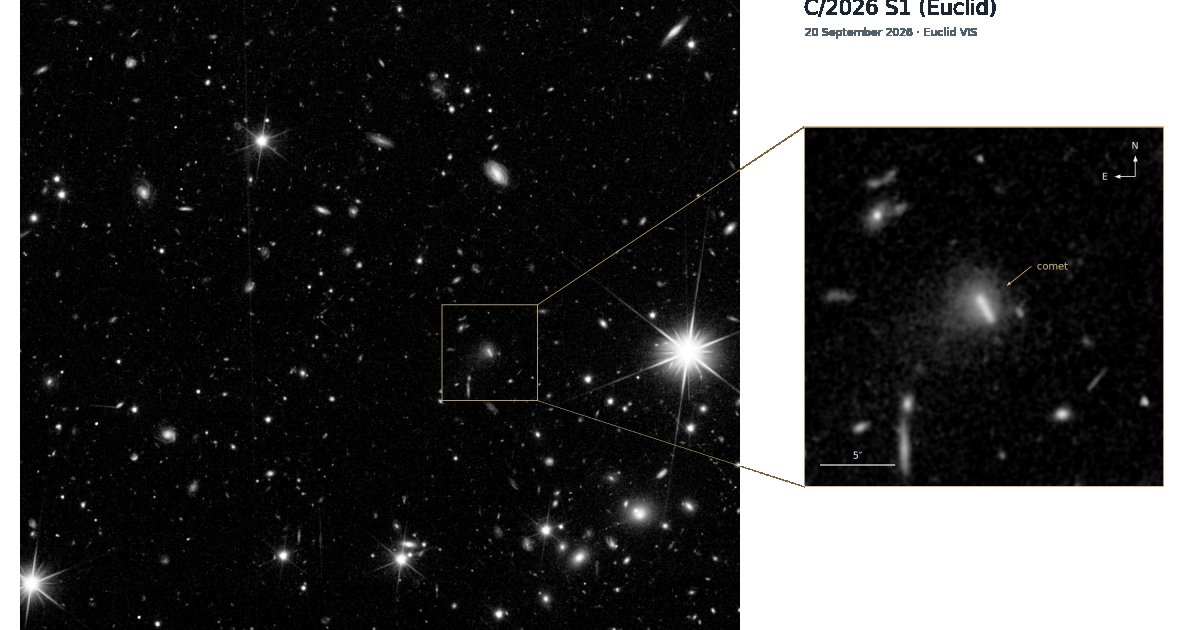
Running that software over observations of the Euclid Deep Field North taken between 16 and 24 September 2026, it flagged a smear of light that belonged to no catalogued star. Pöntinen has described seeing his software flag that streak across several images as an exciting moment. Closer inspection showed something more interesting still: the object was wrapped in a soft, fuzzy halo rather than appearing as a sharp point. That diffuse envelope is the signature of a coma, the cloud of dust and gas released when a comet’s ice begins to sublimate.
By predicting where the object should fall in other frames, he recovered it in five separate image sets, sixteen exposures in total. The detection was reported to the International Astronomical Union’s Minor Planet Center, which alerted ground-based observers. Follow-up observations from Earth pinned down the orbit, and on 8 October 2026 the Minor Planet Center confirmed the object as a comet.
An object far from the crowd
C/2026 S1 sits roughly 1.3 billion kilometres (about 800 million miles) from Earth, a distance that places it, in terms of its separation from the Sun, somewhere between the orbits of Jupiter and Saturn. At that range it is far too faint for amateur equipment; it currently lies in the direction of the constellation Draco.
More striking than its distance is its orbital geometry. Most comets and asteroids keep roughly to the ecliptic, the flat plane in which the planets travel. C/2026 S1 does not. Its path is tilted steeply out of that plane, carrying it high above the Solar System’s traffic lanes, and it takes thousands of years to complete a single circuit of the Sun. Those figures will tighten as more observations accumulate, but they already imply something notable: this is in all likelihood the first time the comet has come into view since telescopes were invented.
That rarity is part of what makes it scientifically interesting. A body that spends almost all of its time in the cold outer Solar System has been shielded from the Sun’s heat, so its ices should preserve something close to the chemistry of the disc from which the planets formed.
Why Euclid almost never finds comets
Bruno Altieri, Euclid’s archive scientist, has called the discovery a happy coincidence, and the description fits the way the telescope works. Euclid’s survey strategy is built around breadth rather than repetition: it sweeps across huge areas of sky and, in the wide survey, visits most patches only once. Comet hunting depends on exactly the opposite, returning to the same field again and again to catch what has moved.
Euclid also deliberately steers clear of the dusty band along the plane of the planets, which is precisely where the great majority of comets and asteroids are found. Taken together, those two choices make a discovery like this one unlikely rather than routine. That the comet turned up in a deep field, where Euclid does revisit the same sky repeatedly to build up sensitivity, is no accident.
A rehearsal for Comet Interceptor
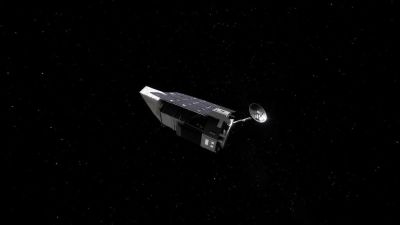
The discovery arrives while ESA prepares Comet Interceptor, a mission designed to wait in space for a suitable target and then fly to a pristine long-period comet, or possibly an interstellar visitor, on its first approach to the inner Solar System.
C/2026 S1 itself is not a suitable candidate for that mission. What the episode did provide, as Altieri has noted, is a live rehearsal of the alert chain: a space telescope spots something unexpected, software flags it, the Minor Planet Center is notified, ground-based observers confirm it, and an orbit emerges within days. When a genuinely suitable target does appear, that speed will matter, because Comet Interceptor will have to commit quickly.
Valeria Pettorino, Euclid’s project scientist, framed the result as something handed to a community outside the mission’s own: a previously unknown comet passed to Solar System researchers by a telescope built to study the opposite end of the distance scale.
What comes next
Astronomers will keep tracking C/2026 S1 from the ground to refine its orbit and watch how its activity develops. Whether the Euclid archive holds other moving objects not yet noticed is an open question, and one Pöntinen’s software is well placed to answer: the deep fields, revisited many times over the mission’s lifetime, are the natural place to look. For a telescope commissioned to measure the expansion of the Universe, picking up a comet on the side is a reminder of how often survey astronomy pays dividends its designers never budgeted for.