Introduction to BepiColombo and MIXS
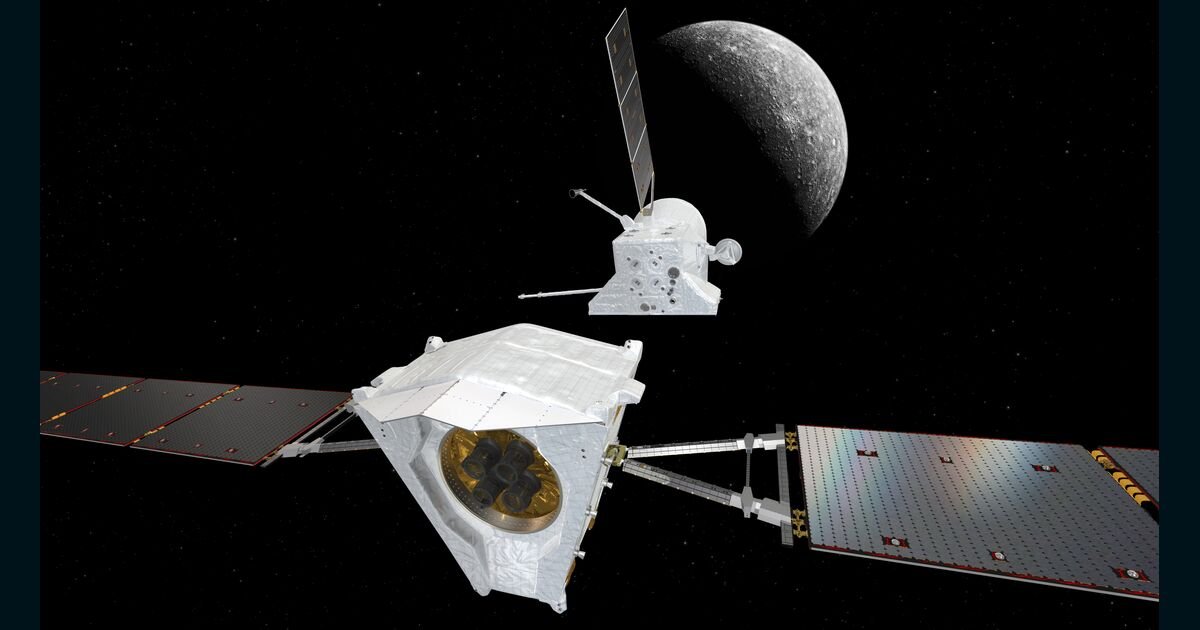
BepiColombo, a joint mission by the European Space Agency (ESA) and the Japan Aerospace Exploration Agency (JAXA), is on a groundbreaking journey to Mercury. One of its key instruments, the Mercury Imaging X-ray Spectrometer (MIXS), recently achieved a major milestone by capturing its first light. This UK-led instrument, developed at the University of Leicester, is the first imaging X-ray telescope to be flown on a planetary mission. MIXS's recent observation of the Crab Nebula marks a significant achievement, demonstrating its capabilities after traveling 10 billion kilometers in space over eight years.
The milestone also arrived at a pivotal moment for the mission. BepiColombo launched in October 2018 and reached Mercury by way of one Earth flyby, two Venus flybys and six Mercury flybys. Its Mercury Transfer Module separated on 3 September 2026, and the spacecraft entered orbit around Mercury on 21 November 2026, making BepiColombo only the second mission ever to orbit the innermost planet after NASA's MESSENGER.
Observing the Crab Nebula
On September 11-12, 2026, MIXS observed the Crab Nebula, a supernova remnant roughly 6,500 light-years away, for more than 39 hours. During this period, the instrument executed 55 orientation changes to capture detailed X-ray images. The Crab Nebula is a well-known calibration target for X-ray telescopes due to its consistent and bright emissions. This observation allowed the MIXS team to validate the instrument's performance and calibration, ensuring it is ready for its primary mission at Mercury.
The successful observation of the Crab Nebula is a testament to MIXS's advanced design and engineering. It is equipped with a novel optics system that allows it to focus X-rays, a challenging task given the high-energy nature of X-ray photons. This capability will enable MIXS to produce detailed maps of Mercury's surface composition by detecting fluorescent X-rays emitted by elements in the planet's crust when bombarded by solar X-rays.
Instrument Performance and Team Efforts
The performance of MIXS during its first light observation has been described as exemplary. According to the Science Daily report, the instrument's ability to maintain precision and stability during prolonged observations and multiple orientation changes is a significant achievement. The data collected from the Crab Nebula will serve as a benchmark for future observations at Mercury.
The MIXS team, led by the University of Leicester, has worked tirelessly to bring this instrument from concept to reality. Their efforts have been supported by various international collaborators, ensuring that MIXS is equipped to handle the harsh conditions of space and the intense radiation environment near Mercury.
Scientific Goals at Mercury
BepiColombo entered orbit around Mercury on 21 November 2026, and its primary science phase is scheduled to begin in April 2027. From then, MIXS takes up its main task: studying the planet's surface composition. By analyzing the X-ray emissions from Mercury's surface, MIXS will help scientists understand the planet's geological history and evolution. This data is crucial for unraveling the mysteries of Mercury's formation and its place in the solar system.
MIXS's observations will complement those of other instruments aboard BepiColombo, providing a comprehensive view of Mercury's environment. The mission aims to address key questions about the planet's magnetic field, exosphere, and interior structure, contributing to our broader understanding of terrestrial planets.
Conclusion
The achievement of first light by MIXS marks a significant milestone for the BepiColombo mission. As the first imaging X-ray telescope on a planetary mission, MIXS is poised to deliver groundbreaking insights into Mercury's composition and history. The successful observation of the Crab Nebula not only validates the instrument's capabilities but also sets the stage for its scientific endeavors at Mercury. With the spacecraft now captured in Mercury orbit, the wait is for the two orbiters to separate in December 2026 and for the science campaign to begin in earnest.