Understanding Hera's Rectangular Orbits
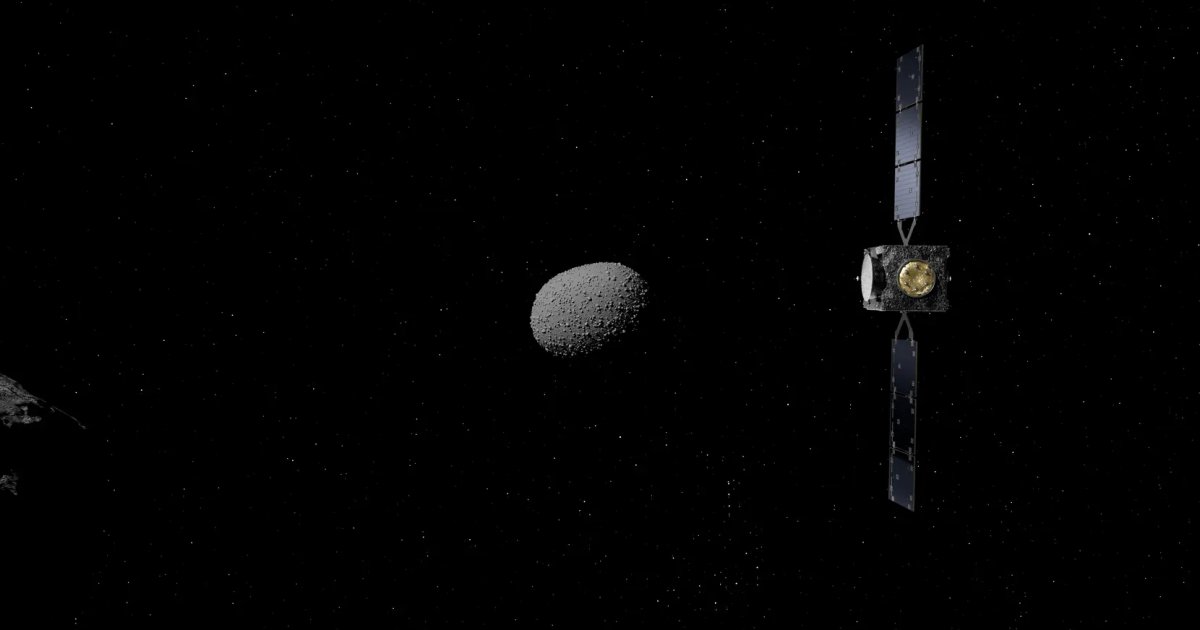
The European Space Agency's (ESA) Hera spacecraft is currently executing a series of rectangular orbits around the Didymos-Dimorphos asteroid system. This unique orbital path is primarily dictated by the weak gravitational forces exerted by these celestial bodies. Didymos, the larger of the two asteroids, measures approximately 780 meters in diameter, while its companion, Dimorphos, is about 151 meters across. Such small sizes result in gravitational forces that are insufficient to maintain stable circular orbits for spacecraft like Hera.
Why Rectangular Orbits?
In the context of the Didymos-Dimorphos system, the gravitational pull is too weak to sustain a traditional circular orbit. As a result, Hera must rely on a series of rectangular orbits, ranging between 25 to 30 kilometers from the asteroids. These orbits are designed to keep the spacecraft within a safe distance while allowing it to conduct its survey operations effectively.
The rectangular orbit strategy is crucial for maintaining Hera's stability and ensuring that it does not drift uncontrollably. The spacecraft's onboard systems are programmed to execute periodic thruster burns, which correct its trajectory and counteract any drift. This drift occurs at a speed of approximately 12 centimeters per second, a rate that can accumulate over time if not corrected.
Surveying the DART Impact Site
Hera's mission includes a detailed survey of the impact site created by NASA's Double Asteroid Redirection Test (DART) mission in 2022. The DART mission aimed to alter the orbit of Dimorphos as a test of planetary defense strategies. Hera's observations are critical for assessing the aftermath of this impact and understanding the effectiveness of kinetic impactors in asteroid deflection.
The Role of Juventas and Milani CubeSats
In addition to Hera's main objectives, the mission includes two CubeSats: Juventas and Milani. These small satellites will be deployed to gather complementary data. Juventas will focus on measuring the internal structure of Dimorphos using a low-frequency radar, while Milani will analyze the surface composition of both asteroids.
Upcoming Bowtie-Shaped Characterisation Phase
As Hera continues its mission, it will enter a new phase of detailed characterization from a distance of approximately 20 kilometers. This phase will involve a bowtie-shaped orbital pattern, allowing for comprehensive mapping and analysis of the asteroids' surfaces and the DART impact site. Scientists estimate that this approach will provide unprecedented insights into the physical and compositional properties of these celestial bodies.
The bowtie-shaped orbit is designed to maximize coverage and data collection, ensuring that Hera can fulfill its mission objectives efficiently. This phase will be critical for enhancing our understanding of asteroid dynamics and the potential for future planetary defense initiatives.
For more detailed information on the Hera mission, you can visit the ESA website or explore recent findings on ScienceDaily.