Introduction to AT 2025abao
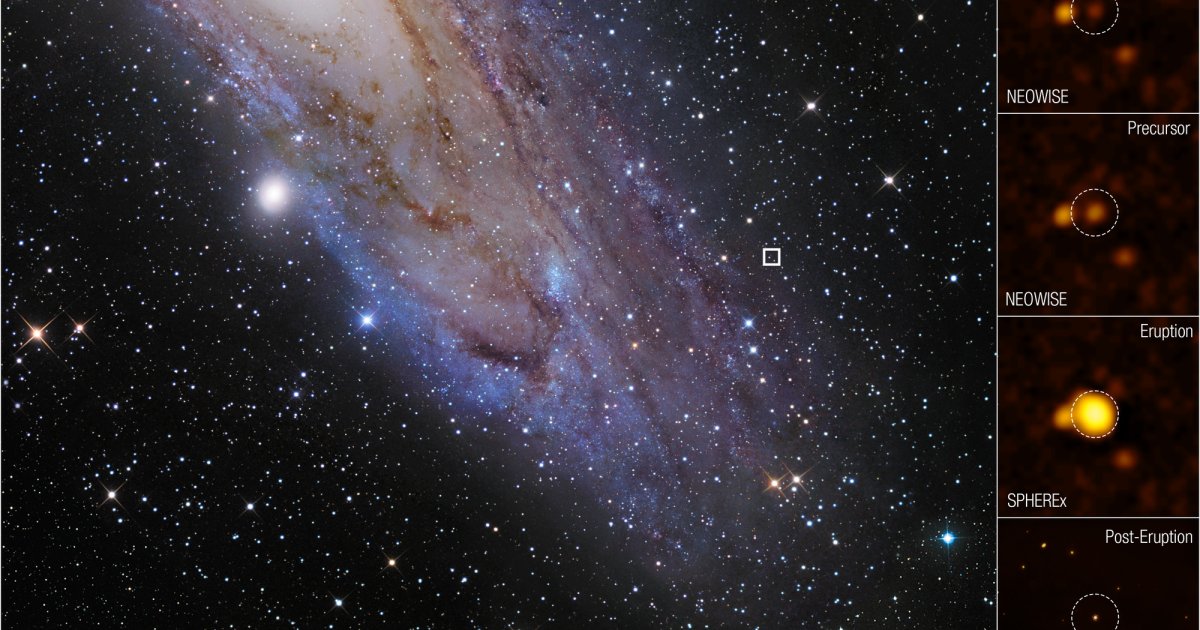
In a groundbreaking observation, the James Webb Space Telescope (JWST) has provided unprecedented insights into a stellar merger event in the Andromeda Galaxy. Designated AT 2025abao, this event involved a smaller star spiraling into and merging with a much larger companion star. The findings, led by Viraj Karambelkar from Columbia University and published in Nature on November 18, 2026, mark a significant milestone in our understanding of stellar dynamics and evolution.
The Dynamics of a Common-Envelope Merger
In this particular event, a star with approximately 0.7 solar masses was observed to spiral into its companion, a massive asymptotic giant branch (AGB) star with about 7 solar masses and a radius of 350 solar radii. This dramatic interaction unfolded over just seven orbits, a remarkably short timespan for such cosmic events. The merger resulted in the ejection of between 0.1 and 0.2 solar masses of material into space.
Understanding the Common-Envelope Phase
The common-envelope phase is a critical stage in the evolution of binary star systems. During this phase, the smaller star becomes engulfed by the outer layers of its larger companion, leading to a spiraling motion that ultimately results in a merger. The gravitational interactions between the two stars cause the envelope to be ejected, often leading to spectacular outbursts observable from Earth.
JWST's Role in Observing AT 2025abao
The JWST's mid-infrared capabilities were crucial in capturing the details of this stellar merger. Observations were conducted 47 days after the initial eruption in October 2025, allowing astronomers to analyze the aftermath of the event. The mid-infrared data provided by JWST enabled researchers to reconstruct the dynamics of the merger with unprecedented clarity.
According to NASA, the telescope's sensitivity to infrared wavelengths allowed it to penetrate the dense dust and gas surrounding the merging stars, revealing the intricate processes at play. This capability is crucial for studying such events, which are often obscured in visible light.
Implications for Stellar Evolution
The observation of AT 2025abao offers valuable insights into the life cycles of binary star systems. Stellar mergers are thought to play a significant role in the evolution of stars, potentially leading to the formation of exotic objects such as blue stragglers or even contributing to the diversity of supernovae.
By studying these events, astronomers can better understand the mechanisms behind mass transfer and loss in binary systems, which are key factors in the lifecycle of stars. As noted in the Sci-News article, these observations help refine models of stellar evolution and provide a clearer picture of how stars interact and evolve over time.
Future Prospects
The successful observation of AT 2025abao highlights the potential of the JWST to uncover new and exciting phenomena in distant galaxies. As scientists continue to analyze the data and search for similar events, our understanding of the universe's most dynamic processes will undoubtedly expand.
For more detailed scientific insights, the research paper by Viraj Karambelkar and colleagues is available on arXiv. As we look to the future, the JWST promises to be an invaluable tool in the ongoing exploration of the cosmos, shedding light on the complex interactions that shape the universe.