Introduction to Protoplanetary Disk Winds
The James Webb Space Telescope (JWST), equipped with the Mid-Infrared Instrument (MIRI), has provided unprecedented insights into the evolution of protoplanetary disk winds around young Sun-like stars. A recent survey led by Bajaj et al. (2026) and published in the Astronomical Journal focuses on 72 such stars, shedding light on how these winds transform as the disks age. This transformation is crucial for understanding the timeline of gas-giant planet formation.
From Magnetically Driven Jets to Photoevaporative Winds
The study reveals that protoplanetary disks initially exhibit winds driven by magnetic fields, known as magnetically driven jets. As the disks mature, these jets evolve into molecular winds, and eventually, into photoevaporative atomic winds. This evolution is critical because it influences how quickly the gas in the disk disperses, setting a 'hard clock' on the formation of gas giants like Jupiter.
The Case of T Cha
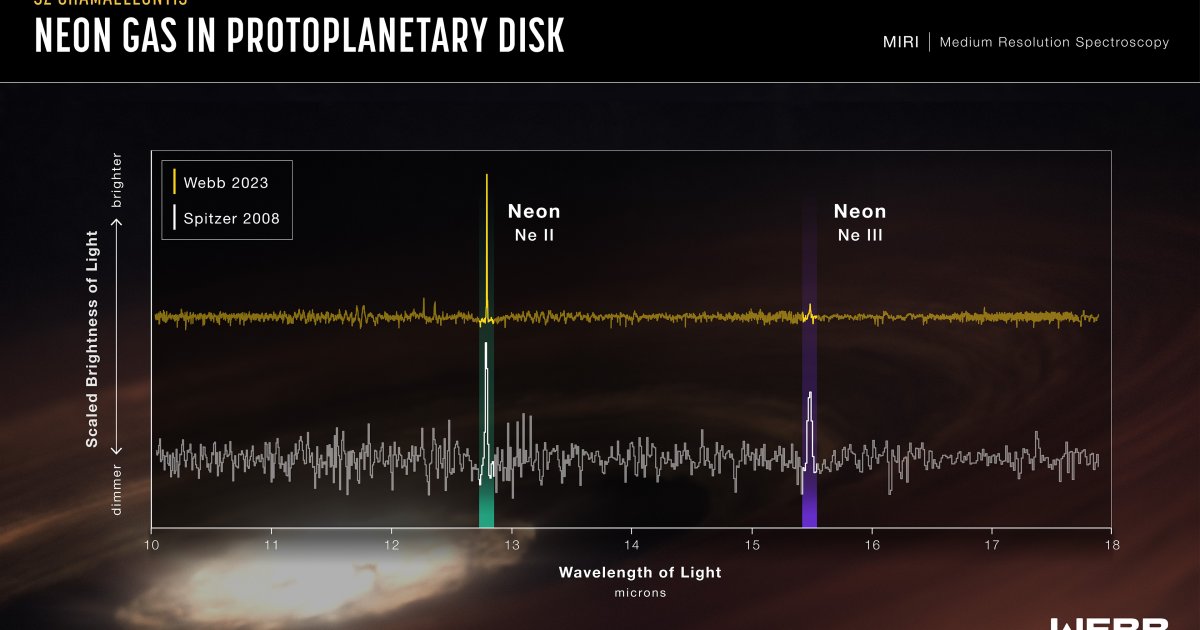
T Cha, a young star included in the survey, exemplifies this evolutionary process. Observations indicate that T Cha's disk is transitioning from molecular to photoevaporative winds. This transition is marked by the presence of specific atomic emissions, particularly neon and argon, which serve as diagnostics for the disk's wind phase. These elements are detected through their distinct spectral lines in the infrared, thanks to MIRI's sensitivity.
Neon and Argon as Wind Diagnostics
The presence of neon and argon in the disk winds of T Cha and similar stars provides critical clues about the disk's current state. Neon, often ionized in the harsh radiation environment of young stars, signals the onset of photoevaporative winds. Argon, meanwhile, offers complementary data about the ionization conditions and the temperature of the disk's outer layers. These elements help astronomers pinpoint when the disk transitions from being gas-rich to gas-poor, a key factor in determining the window for gas-giant formation.
Implications for Gas-Giant Planet Formation
The dispersal of gas in protoplanetary disks is a pivotal process in planet formation. The study estimates that disk winds can clear out the gas in a few million years. This relatively short timescale means that gas-giant planets must form quickly, before the disk loses its gas content. If the gas disperses too soon, the opportunity to build massive planets like Jupiter diminishes significantly.
Understanding these timelines is essential for constructing accurate models of planetary system formation. The insights gained from the JWST/MIRI survey not only enhance our knowledge of disk winds but also refine our predictions about the conditions necessary for the formation of gas giants in other star systems.
Conclusion
The JWST/MIRI survey led by Bajaj et al. (2026) marks a significant advancement in our understanding of protoplanetary disk winds and their role in planet formation. By tracing the evolution from magnetically driven jets to photoevaporative winds, the study highlights the critical period during which gas giants must form. As astronomers continue to analyze data from JWST, these findings will undoubtedly influence future research on planetary system development.
For more detailed insights, you can explore the SETI Institute's coverage and the original research paper.