Hubble image archive
The Cygnus Loop Nebula: Shockwave from a Stellar Explosion
This image shows a small portion of a nebula called the "Cygnus Loop." Covering a region on the sky six times the diameter of the full Moon, the Cygnus Loop is actually the expanding blastwave from a stellar cataclysm - a supernova explosion - which occurred about 15,000 years ag...
- Date
- Jan 1, 1995
- Mission
- Hubble Space Telescope
- Archive ID
- hubblesite-images-1995-11-272-image
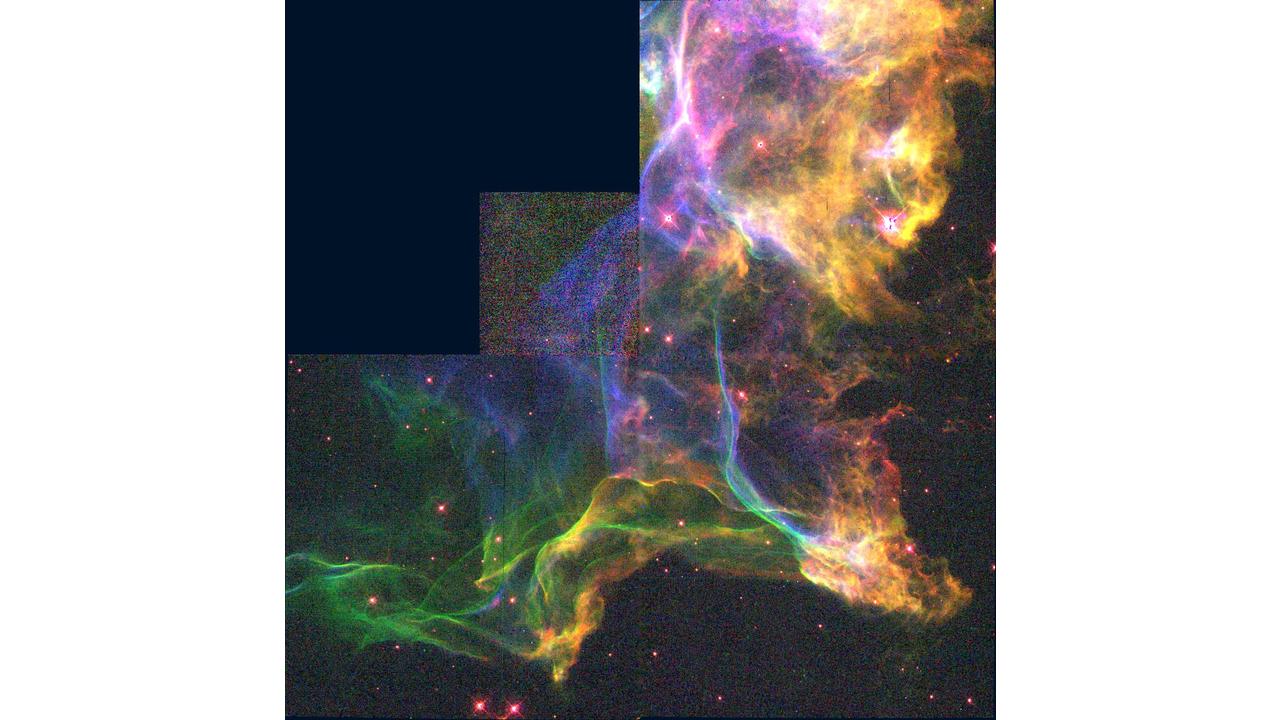
This image shows a small portion of a nebula called the "Cygnus Loop." Covering a region on the sky six times the diameter of the full Moon, the Cygnus Loop is actually the expanding blastwave from a stellar cataclysm - a supernova explosion - which occurred about 15,000 years ago. In this image the supernova blast wave, which is moving from left to right across the field of view, has recently hit a cloud of denser than average interstellar gas. This collision drives shock waves into the cloud that heats interstellar gas, causing it to glow. Just as the microscope revolutionized the study of the human body by revealing the workings of cells, the Hubble Space Telescope is offering astronomers an unprecedented look at fine structure within these shock fronts. Astronomers have been performing calculations of what should go on behind shock fronts for about the last 20 years, but detailed observations have not been possible until Hubble. This image was taken with Hubble's Wide Field and Planetary Camera 2 (WFPC2). The color is produced by composite of three different images. Blue shows emission from "doubly ionized" oxygen atoms (atoms that have had two electrons stripped away) produced by the heat behind the shock front. Red shows light given off by "singly ionized" sulfur atoms (sulfur atoms that are missing a single electron). This sulfur emission arises well behind the shock front, in gas that has had a chance to cool since the passage of the shock. Green shows light emitted by hydrogen atoms. Much of the hydrogen emission comes from an extremely thin zone (only several times the distance between the Sun and Earth) immediately behind the shock front itself. These thin regions appear as sharp, green, filaments in the image. This supernova remnant lies 2,500 light-years away in the constellation Cygnus the Swan.
Credits
Credit: Jeff Hester (Arizona State University) and NASAImage Details
| About The Object | |
|---|---|
| Object Name | Cygnus Loop |
| R.A. Position | 20h 51m 6.0s |
| Dec. Position | 30° 40' 59.99" |
Downloads
Source
Image and source material are credited to the official mission archive linked below.
View on NASA.gov