Hubble image archive
HST Reveals Growth Processes of Young Star, Herbig-Haro Object #2
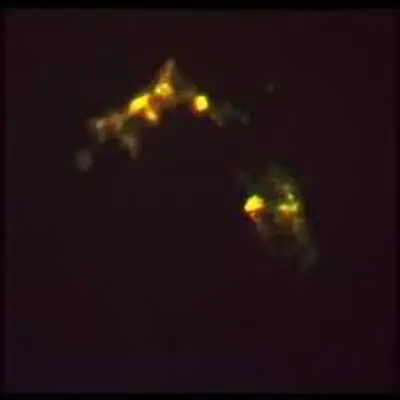
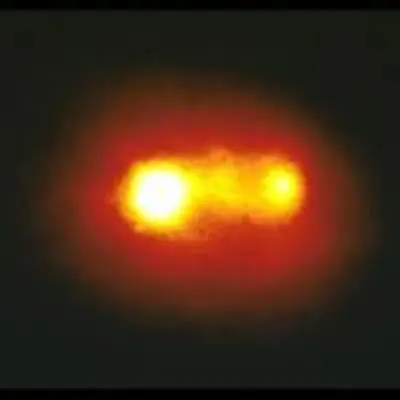
A NASA Hubble Space Telescope (HST) image of a vast cloud of gas being heated by the birth of a new star. This image is being presented at the 182nd meeting of the American Astronomical Society in Berkeley, California. Called Herbig-Haro object #2 (HH-2), the cloud is heated by s...
- Date
- Jan 1, 1993
- Mission
- Hubble Space Telescope
- Archive ID
- hubblesite-images-1993-17-108-image

A NASA Hubble Space Telescope (HST) image of a vast cloud of gas being heated by the birth of a new star. This image is being presented at the 182nd meeting of the American Astronomical Society in Berkeley, California. Called Herbig-Haro object #2 (HH-2), the cloud is heated by shock waves from jets of high speed gas being ejected from a newborn star. Because the star itself is embedded in a dusty cocoon, HH-2 provides the only visible clues to physical processes occurring in the young star. The Hubble observations made with the Wide Field/Planetary Camera WF/PC) provide new insight into similar events that probably occurred when our Sun and Solar System formed 4.6 billion years ago. HH-2 lies at a distance of about 1,500 light-years, in a star-forming region of the constellation Orion. The object is located at the leading edge of a supersonic gas flow that emanates from a young star located about 1/2 light-year from the object. The star is detectable only with infrared and radio telescopes. The high-speed jets that create HH-2 form as a young star contracts under its own gravitational pull. The star reaches a stage where it releases a strong outflow of gas. A thick disk of cool gas and dust around the star, perhaps coupled with a strong magnetic field, forces the hot gas to squirt outward along the system's rotational axis. This forms a pair of narrow jets that plow through the gas of the parent cloud in the star formation region. The supersonic flow forms strong shock waves, heating gas in the parent cloud to temperatures more than 200,000 degrees Fahrenheit (93,000 degrees Celsius). Though a cocoon of dust obscures the star from view, the effects of the jets can be seen across great distances. The hot gas radiates energy in visible light associated with atoms of hydrogen, oxygen, nitrogen, sulfur, and other common elements, forming the structure of a Herbig-Haro object.
Credits
Credit: Dick Schwatrz (Univ. of Missouri-St. Louis), and NASAImage Details
| About The Object | |
|---|---|
| Object Name | HH-2 |
| R.A. Position | 05h 36m 24.0s |
| Dec. Position | -6° 46' 59.99" |
More Images From This Period

Downloads
Source
Image and source material are credited to the official mission archive linked below.
View on NASA.gov