Hubble image archive
Core of the Globular Cluster NGC 6624
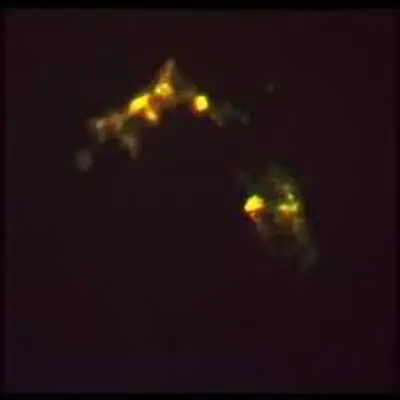
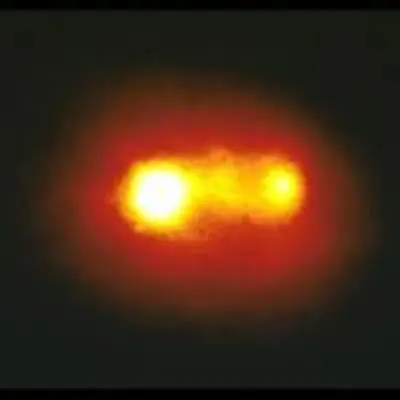
This is a comparison of pictures of the core of the globular cluster NGC 6624, as imaged with the European Space Agency's Faint Object Camera aboard NASA's Hubble Space Telescope. This comparison image demonstrates that Hubble's high resolution and ultraviolet sensitivity allow a...
- Date
- Jan 1, 1993
- Mission
- Hubble Space Telescope
- Archive ID
- hubblesite-images-1993-20-113-image

This is a comparison of pictures of the core of the globular cluster NGC 6624, as imaged with the European Space Agency's Faint Object Camera aboard NASA's Hubble Space Telescope. This comparison image demonstrates that Hubble's high resolution and ultraviolet sensitivity allow astronomers to pick out the faint blue counterpart to an X-ray burster buried in the globular cluster. (An X-ray burster is a class of unusual double star that is a source of violent bursts of X-rays.) HST clearly distinguishes the star from others crammed together in the dense core of the cluster.
The image on the left shows that one star far outshines all others in the cluster's core when viewed at UV wavelengths. Nearly all the fainter stars in this UV image coincide with bright stars in the image on the right, which was taken in visible (blue) light. They are all cool red stars. When the two images are lined up, the UV-bright star coincides with the inconspicuous star that is identified by tic-marks in the right-hand image. It is the bluest (and therefore hottest) star in the cluster and is at the position of an X-ray source known as 4U 1820-30 (first identified as a bright X-ray source in the 1970s during an all sky survey carried out by the Uhuru satellite).
The X-ray source is known to be a binary star consisting of a neutron star and white dwarf that complete an orbit about each other every eleven minutes. The UV radiation comes from a disk of gas surrounding the neutron star.
The double star lies only 1/10 of a light-year from the exact center of the globular star cluster, which is identified by a "+". This closeness follows from tying the HST observations to ground-based observations that place the true center of the cluster in a different location from that determined by earlier ground-based estimates.
The cluster is located approximately 28,000 light-years away in the constellation Sagittarius.
Image Details
| About The Object | |
|---|---|
| Object Name | NGC 6624 |
| R.A. Position | 18h 23m 40.69s |
| Dec. Position | -30° 21' 38.8" |
More Images From This Period

Downloads
Source
Image and source material are credited to the official mission archive linked below.
View on NASA.gov