Hubble image archive
Microlensing Infographic
This graphic illustrates a microlensing event, which occurs when the light from a distant object warps as a mass, such as a star (depicted here) or a stellar-mass black hole, precisely aligns in front of that object. In this image, a red, foreground star intervenes between the te...
- Date
- Sep 8, 2026
- Mission
- Hubble Space Telescope
- Archive ID
- microlensing-infographic
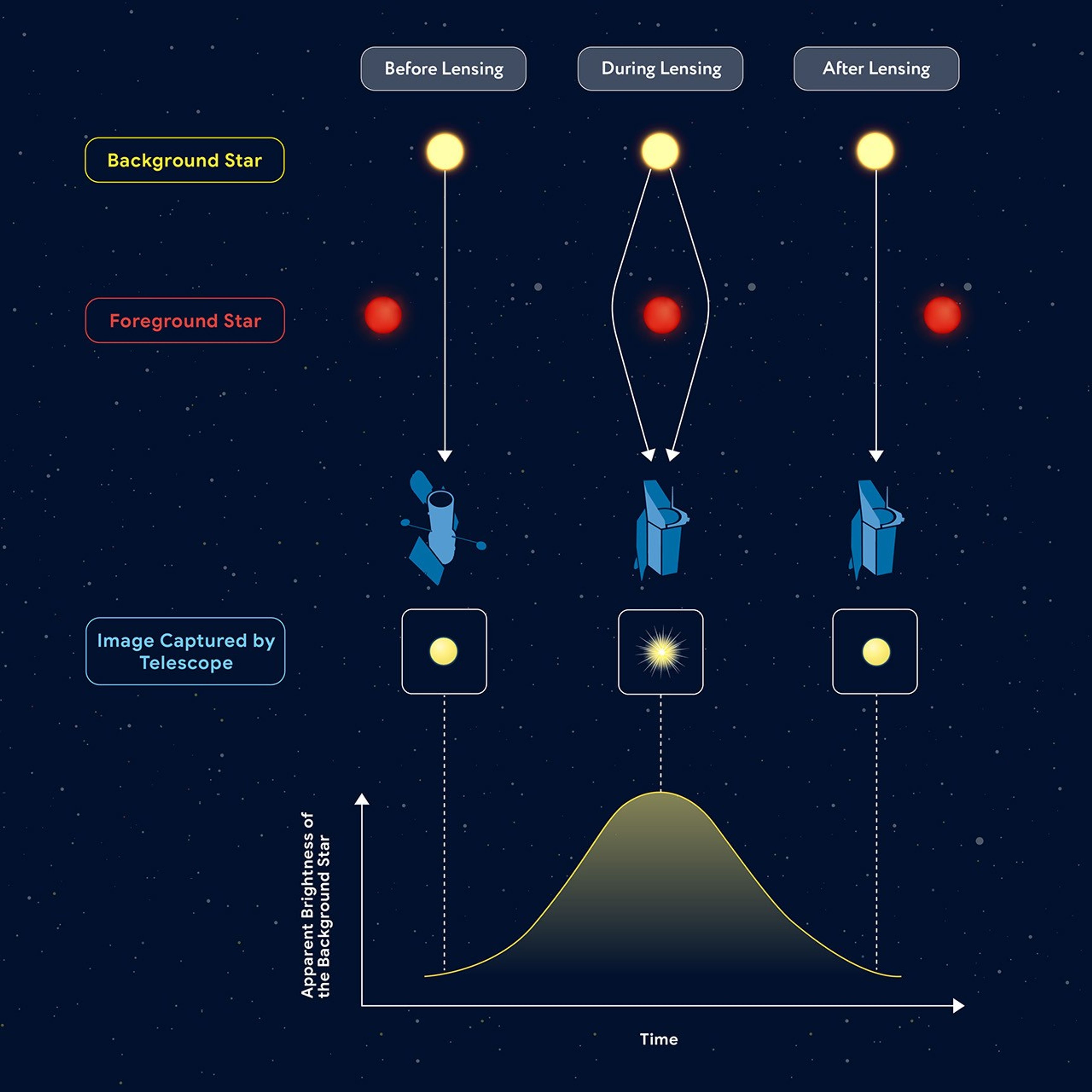
This graphic illustrates a microlensing event, which occurs when the light from a distant object warps as a mass, such as a star (depicted here) or a stellar-mass black hole, precisely aligns in front of that object. In this image, a red, foreground star intervenes between the telescope, acting as the "lens," bending, and magnifying the light of the yellow background star. Unlike some gravitational lensing events, which occur at the scale of galaxies or galaxy clusters, microlensing events occur on a much smaller scale, such as that of individual stars. The lensing effect is, therefore, much smaller.
This image also provides a representation of what the background star would look like to a telescope in a microlensing event. Because of the curvature of space around the foreground star (represented by the white arrows that curve around it in the image), the background star appears to increase in brightness as the event begins before decreasing in apparent brightness as it falls out of alignment. The graph at bottom plots the apparent brightness of the background star over time. Hubble observations taken before microlensing events (left) will help astronomers better analyze Roman data taken during (middle) and after (right) those same events.
More Images From This Period
Source
Image and source material are credited to the official mission archive linked below.
View on NASA.gov