Hubble image archive
Saturn Compass Image
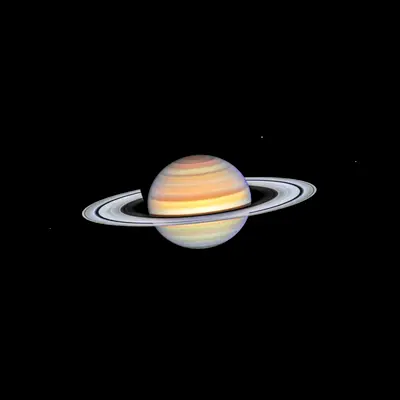
This photo of Saturn was taken by NASA's Hubble Space Telescope on October 22, 2023, when the ringed planet was approximately 850 million miles from Earth. Hubble's ultra-sharp vision reveals a phenomenon called ring spokes. Saturn's spokes are transient features that rotate alon...
- Date
- Dec 21, 2023
- Mission
- Hubble Space Telescope
- Archive ID
- hubblesite-images-2023-023-01hgxcccpdx0r8mzqdn216bksp

This photo of Saturn was taken by NASA's Hubble Space Telescope on October 22, 2023, when the ringed planet was approximately 850 million miles from Earth. Hubble's ultra-sharp vision reveals a phenomenon called ring spokes.
Saturn's spokes are transient features that rotate along with the rings. Their ghostly appearance only persists for two or three rotations around Saturn. During active periods, freshly-formed spokes continuously add to the pattern.
In 1981, NASA's Voyager 2 first photographed the ring spokes. NASA's Cassini orbiter also saw the spokes during its 13-year-long mission that ended in 2017.
Hubble continues observing Saturn annually as the spokes come and go. This cycle has been captured by Hubble's Outer Planets Atmospheres Legacy (OPAL) program that began nearly a decade ago to annually monitor weather changes on all four gas-giant outer planets.
Hubble's crisp images show that the frequency of spoke apparitions is seasonally driven, first appearing in OPAL data in 2021 but only on the morning (left) side of the rings. Long-term monitoring show that both the number and contrast of the spokes vary with Saturn's seasons. Saturn is tilted on its axis like Earth and has seasons lasting approximately seven years.
"We are heading towards Saturn equinox, when we'd expect maximum spoke activity, with higher frequency and darker spokes appearing over the next few years," said the OPAL program lead scientist, Amy Simon of NASA's Goddard Space Flight Center in Greenbelt, Maryland.
This year, these ephemeral structures appear on both sides of the planet simultaneously as they spin around the giant world. Although they look small compared with Saturn, their length and width can stretch longer than Earth's diameter!
The leading theory is that spokes are tied to Saturn's powerful magnetic field, with some sort of solar interaction with the magnetic field that gives you the spokes. When it's near the equinox on Saturn, the planet and its rings are less tilted away from the Sun. In this configuration, the solar wind may more strongly batter Saturn's immense magnetic field, enhancing spoke formation.
Planetary scientists think that electrostatic forces generated from this interaction levitate dust or ice above the ring to form the spokes, though after several decades no theory perfectly predicts the spokes. Continued Hubble observations may eventually help solve the mystery.
Credits
Science
NASA, ESA, STScI, Amy Simon (NASA-GSFC)
Image Details
| About The Object | |
|---|---|
| Object Name | Saturn |
| Object Description | Gas giant with rings |
| About The Data | |
| Data Description | This image was created with Hubble data from proposal: 16995 (A. Simon). Image Processing: Joseph DePasquale (STScI) |
| Instrument | WFC3/UVIS |
| Exposure Dates | 22 October 2023 |
| Filters | F395N, F502N, F631N |
| About The Image | |
| Color Info | These images are a composite of separate exposures acquired by the Hubble Space Telescope using the WFC3/UVIS instrument. Several filters were used to sample specific wavelength ranges. The color results from assigning different hues (colors) to each monochromatic (grayscale) image associated with an individual filter. In this case, the assigned colors are: Red: F631N, Green: F502N, Blue: F395N |
More Images From This Period

Downloads
Source
Image and source material are credited to the official mission archive linked below.
View on NASA.gov