Hubble image archive
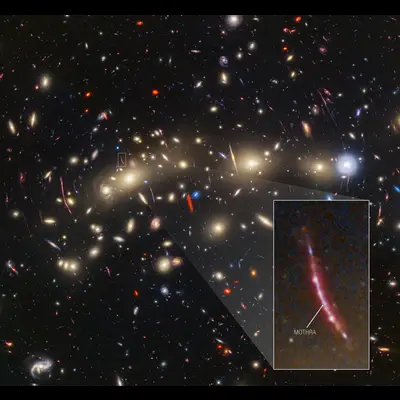
MACS 0416 (Hubble and Webb Compared)
This side-by-side comparison of galaxy cluster MACS0416 as seen by the Hubble Space Telescope in optical light (left) and the James Webb Space Telescope in infrared light (right) reveals different details. Both images feature hundreds of galaxies, however the Webb image shows gal...
- Date
- Nov 10, 2023
- Mission
- Hubble Space Telescope
- Archive ID
- hubblesite-images-2023-146-01hdhhrz9ktfxh9z94edayd9ve

This side-by-side comparison of galaxy cluster MACS0416 as seen by the Hubble Space Telescope in optical light (left) and the James Webb Space Telescope in infrared light (right) reveals different details. Both images feature hundreds of galaxies, however the Webb image shows galaxies that are invisible or only barely visible in the Hubble image. This is because Webb’s infrared vision can detect galaxies too distant or dusty for Hubble to see. (Light from distant galaxies is redshifted due to the expansion of the universe.) The total exposure time for Webb was about 22 hours, compared to 122 hours of exposure time for the Hubble image.
Credits
Image
NASA, ESA, CSA, STScI
Image Details
| About The Object | |
|---|---|
| Object Name | MACS J0416.1-2403 |
| Object Description | Lensing Galaxy Cluster |
| R.A. Position | 04:16:9.89 |
| Dec. Position | -24:03:58.0 |
| Constellation | Eridanus |
| About The Data | |
| Data Description | These images were created with Hubble data from proposals (M. Postman), (J. Lotz), and (S. Rodney) as well as Webb data from proposals: and (R. Windhorst). Image Processing: Joseph DePasquale (STScI) |
| Instrument | HST ACS & WFC3; JWST NIRCam |
| Exposure Dates | HST: July 2012 - Feb 2023 JWST: 7 Oct 2022, 29 Dec 2022, 10 Feb 2022 |
| Filters | HST ACS: F435W, F606W, F814W; WFC3/IR: F105W, F125W, F140W, F160W; JWST NIRCam: F090W, F115W, F150W, F200W, F277W, F356W, F410M, F444W |
Downloads
Source
Image and source material are credited to the official mission archive linked below.
View on NASA.gov