Hubble image archive
MACSJ 0138
Three Times a Charm: Hubble Spots Three Images of a Distant Supernova Now you see them, now you don't. Three views of the same supernova appear in the 2016 image on the left, taken by the Hubble Space Telescope. But they're gone in the 2019 image. The distant supernova, named Req...
- Date
- Jan 1, 2021
- Mission
- Hubble Space Telescope
- Archive ID
- hubblesite-images-2021-030-01f9kzx19d6bzjg86j3a3e8fw5
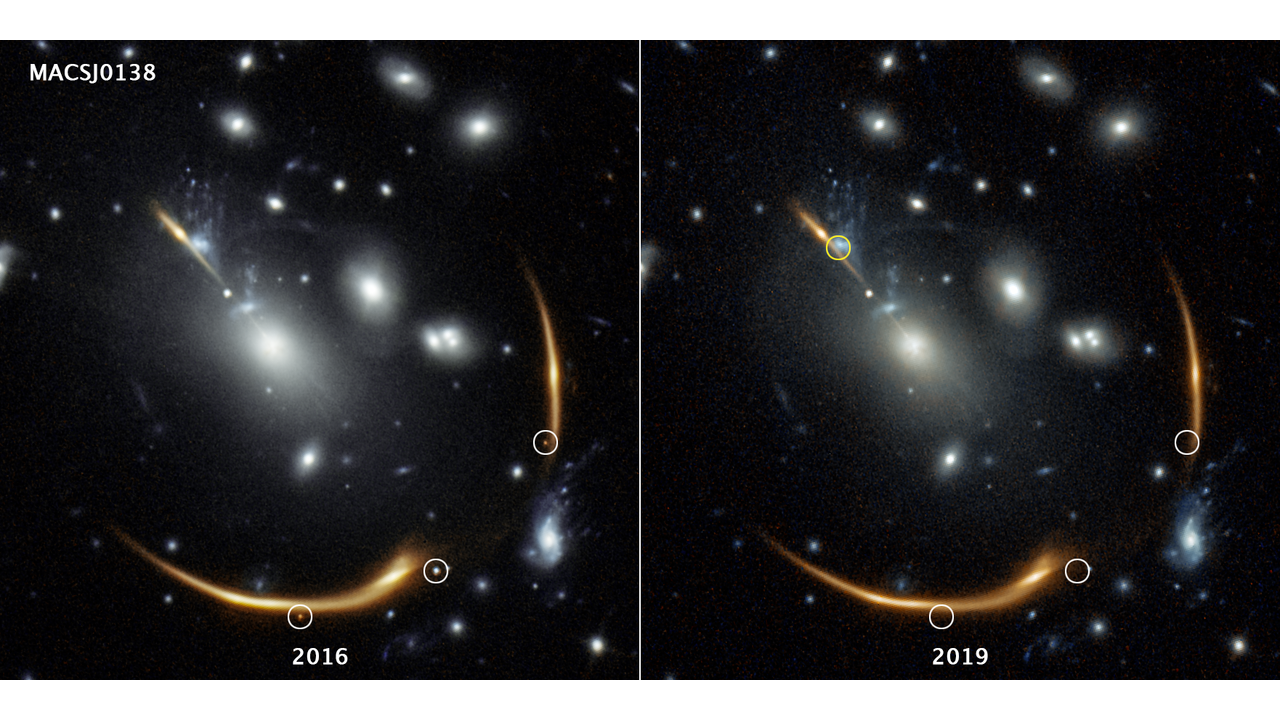
Three Times a Charm: Hubble Spots Three Images of a Distant Supernova
Now you see them, now you don't.
Three views of the same supernova appear in the 2016 image on the left, taken by the Hubble Space Telescope. But they're gone in the 2019 image. The distant supernova, named Requiem, is embedded in the giant galaxy cluster MACS J0138. The cluster is so massive that its powerful gravity bends and magnifies the light from the supernova, located in a galaxy far behind it. Called gravitational lensing, this phenomenon also splits the supernova's light into multiple mirror images, highlighted by the white circles in the 2016 image.
The multiply imaged supernova disappears in the 2019 image of the same cluster, at right. The snapshot, taken in 2019, helped astronomers confirm the object's pedigree. Supernovae explode and fade away over time. Researchers predict that a rerun of the same supernova will make an appearance in 2037. The predicted location of that fourth image is highlighted by the yellow circle at top left.
The light from Supernova Requiem needed an estimated 10 billion years for its journey, based on the distance of its host galaxy. The light that Hubble captured from the cluster, MACS J0138.0-2155, took about 4 billion years to reach Earth.
The images were taken in near-infrared light by Hubble's Wide Field Camera 3.
Credits
Lead Author
Steve A. Rodney (University of South Carolina), Gabriel Brammer (Cosmic Dawn Center/Niels Bohr Institute/University of Copenhagen)
Image Processing
Joseph DePasquale (STScI)
Image Details
| About The Object | |
|---|---|
| Object Name | MACSJ0138 |
| Object Description | Galaxy cluster with gravitationally lensed supernova |
| R.A. Position | 01:38:03.91 |
| Dec. Position | -21:55:49.32 |
| Constellation | Cetus |
| Distance | About 10 billion light-years (distance to galaxy hosting the supernova at redshift z=1.95) |
| Dimensions | Image is about 43 arcsec across (about 2 billion light-years at redshift z=1.95) |
| About The Data | |
| Data Description | The Hubble image was created from HST data from proposals: (M. Akhshik) and (A. Newman) |
| Instrument | WFC3/IR |
| Exposure Dates | July 2016 and July 2019 |
| Filters | F105W, F110W, F140W, F160W |
| About The Image | |
| Color Info | These images are a composite of separate exposures acquired by the WFC3/IR instrument on the Hubble Space Telescope. Several filters were used to sample narrow wavelength ranges. The color results from assigning different hues (colors) to each monochromatic (grayscale) image associated with an individual filter. In this case, the assigned colors are: Cyan: F105W and F110WOrange: F140W and F160W |
More Images From This Period
Downloads
Source
Image and source material are credited to the official mission archive linked below.
View on NASA.gov