Hubble image archive
Exoplanet GJ 3470 b Structure
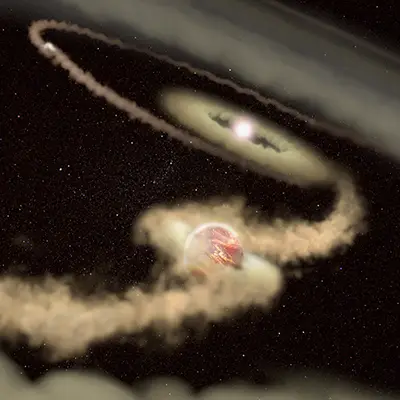
This artist's illustration shows the theoretical internal structure of the exoplanet GJ 3470 b. It is unlike any planet found in the Solar System. Weighing in at 12.6 Earth masses the planet is more massive than Earth but less massive than Neptune. Unlike Neptune, which is 3 bill...
- Date
- Jan 1, 2019
- Mission
- Hubble Space Telescope
- Archive ID
- hubblesite-images-2019-38-4553-image

This artist's illustration shows the theoretical internal structure of the exoplanet GJ 3470 b. It is unlike any planet found in the Solar System. Weighing in at 12.6 Earth masses the planet is more massive than Earth but less massive than Neptune. Unlike Neptune, which is 3 billion miles from the Sun, GJ 3470 b may have formed very close to its red dwarf star as a dry, rocky object. It then gravitationally pulled in hydrogen and helium gas from a circumstellar disk to build up a thick atmosphere. The disk dissipated many billions of years ago, and the planet stopped growing. The bottom illustration shows the disk as the system may have looked long ago. Observations by NASA's Hubble and Spitzer space telescopes have chemically analyzed the composition of GJ 3470 b's very clear and deep atmosphere, yielding clues to the planet's origin. Many planets of this mass exist in our galaxy.
Credits
NASA, ESA, and L. Hustak (STScI)Image Details
| About The Object | |
|---|---|
| Object Name | GJ 3470 b |
| Object Description | Exoplanet |
| R.A. Position | 07:59:05.69 |
| Dec. Position | +15:23:28.71 |
| Constellation | Cancer |
| Distance | About 100 light-years |
| About The Data | |
| Data Description | The HST observations include those from program (B. Benneke) |
| Instrument | WFC3/IR; STIS/CCD |
| Exposure Dates | Jan 2015 - Apr 2016 |
More Images From This Period
Downloads
Source
Image and source material are credited to the official mission archive linked below.
View on NASA.gov