Hubble image archive
Galactic Bulge
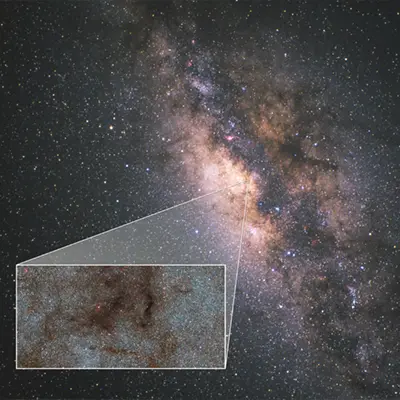
This photo looking toward the center of the Milky Way galaxy covers 0.5 by 0.25 degrees on the sky (an area about twice as wide as the full Moon) and contains over 180,000 stars. The image captures a portion of our galaxy about 220 by 110 light-years across. It was taken with the...
- Date
- Jan 1, 2020
- Mission
- Hubble Space Telescope
- Archive ID
- hubblesite-images-2020-56-4762-image

This photo looking toward the center of the Milky Way galaxy covers 0.5 by 0.25 degrees on the sky (an area about twice as wide as the full Moon) and contains over 180,000 stars. The image captures a portion of our galaxy about 220 by 110 light-years across. It was taken with the Dark Energy Camera on the Victor M. Blanco 4-meter Telescope at the Cerro-Tololo Inter-American Observatory in Chile, a Program of NSF's NOIRLab.
By studying the brightnesses of these stars at different wavelengths of light, astronomers were able to determine how many heavy elements they contain, which is related to their formation history. The team concluded that the majority of stars in our galaxy’s central bulge were formed in a single burst of star formation some 10 billion years ago.
Credits
CTIO/NOIRLab/NSF/AURA/STScI, W. Clarkson (UM-Dearborn), C. Johnson (STScI), and M. Rich (UCLA)Image Details
| About The Object | |
|---|---|
| Object Name | Milky Way |
| Object Description | Stars in the Galactic Bulge |
| R.A. Position | 17:58:57.92 |
| Dec. Position | -29:12:11.35 |
| Distance | About 25,000 light-years from Earth |
| Dimensions | 30 arcminutes across (about 220 light-years) |
| About The Data | |
| Instrument | CTIO Blanco DECam |
| Filters | F485W, F635W, F925W |
| About The Image | |
| Color Info | These images are a composite of separate exposures acquired by the DECam instrument on the Blanco 4-meter telescope. Several filters were used to sample specific wavelength ranges. The color results from assigning different hues (colors) to each monochromatic (grayscale) image associated with an individual filter. In this case, the assigned colors are: blue: F485W green: F635W red: F925W |
More Images From This Period
Downloads
Source
Image and source material are credited to the official mission archive linked below.
View on NASA.gov