Hubble image archive
Artist's Impression of Kepler 138 Planetary System
In this illustration super-Earth Kepler-138 d is in the foreground. To the left, the planet Kepler-138 c, and in the background the planet Kepler 138 b, seen in silhouette transiting its central star. Kepler 138 is a red dwarf star located 218 light-years away. The low density of...
- Date
- Jan 1, 2022
- Mission
- Hubble Space Telescope
- Archive ID
- hubblesite-images-2022-048-01ggtf3hm9nzb45dc762fw81n5
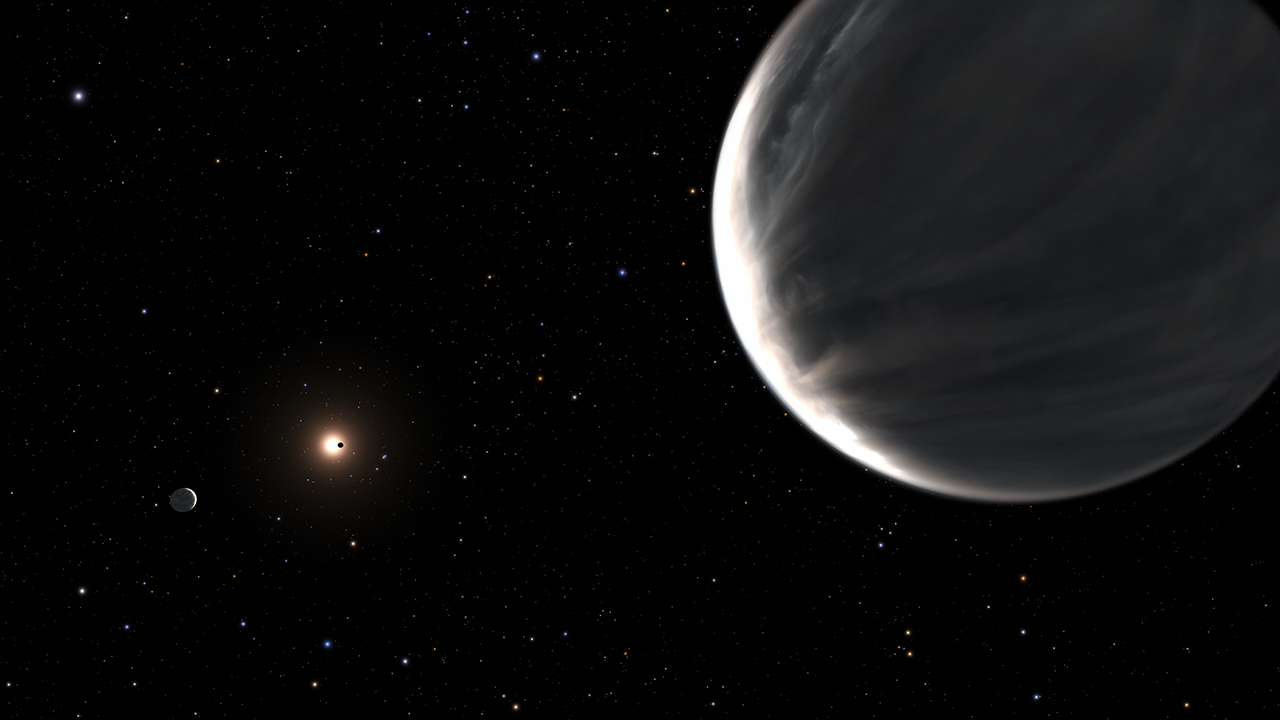
In this illustration super-Earth Kepler-138 d is in the foreground. To the left, the planet Kepler-138 c, and in the background the planet Kepler 138 b, seen in silhouette transiting its central star. Kepler 138 is a red dwarf star located 218 light-years away. The low density of Kepler-138 c and Kepler-138 d — which are nearly identical in size — means that they must be composed largely of water. They are both twice Earth's mass but have roughly half of Earth's density, and therefore cannot be solid rock. This is based on measurements of their mass versus physical diameter. They are considered a new class of "water planet," unlike any major planet found in our solar system. Kepler-138 b is one of the smallest exoplanets known, having the mass of the planet Mars and the density of rock.
Credits
Illustration
NASA, ESA, Leah Hustak (STScI)
Downloads
Source
Image and source material are credited to the official mission archive linked below.
View on NASA.gov