Hubble image archive
Distant Galaxy in GOODS-North
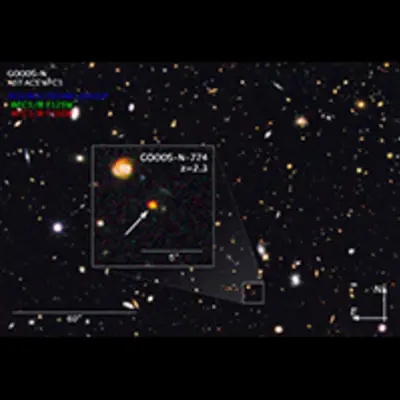
The core of an emerging galaxy is ablaze with newly formed stars in this never-before-seen view of the early construction phase of an elliptical galaxy. Astronomers spotted the glowing core in this Hubble Space Telescope image from the Great Observatories Origins Deep Survey (GOO...
- Date
- Jan 1, 2014
- Mission
- Hubble Space Telescope
- Archive ID
- hubblesite-images-2014-37-3408-image

The core of an emerging galaxy is ablaze with newly formed stars in this never-before-seen view of the early construction phase of an elliptical galaxy. Astronomers spotted the glowing core in this Hubble Space Telescope image from the Great Observatories Origins Deep Survey (GOODS). The arrow in the enlarged inset image points to the growing galaxy's bright, compact core. The galaxy is seen as it appeared 11 billion years ago, just 3 billion years after the Big Bang.
Although only a fraction of the size of the Milky Way, the tiny powerhouse galaxy already contains about twice as many stars as our galaxy, all crammed into a region only 6,000 light-years across. The Milky Way is about 100,000 light-years across. Astronomers think the newly formed galaxy will continue to grow, possibly becoming similar to the giant elliptical galaxies seen today. This barely visible galaxy may be representative of a much larger population of similar objects that are obscured by dust.
The image combines observations taken in near-infrared light with the Wide Field Camera 3 and exposures made in visible light with the Advanced Camera for Surveys.
Credits
NASA, ESA, and G. Illingworth (University of California, Santa Cruz), and the GOODS teamImage Details
| About The Object | |
|---|---|
| Object Name | GOODS-N-774, "Sparky" |
| Object Description | Distant Galaxy in GOODS-North Field |
| R.A. Position | 12h 36m 27.73s |
| Dec. Position | 62° 7' 12.77" |
| Constellation | Fornax |
| Distance | z=2.3 |
| About The Data | |
| Data Description | Hubble data for this release were obtained from the following proposals: : P. van Dokkum (Yale University) et al. A multitude of archival HST data was used for these findings, including, but not limited to: grism spectroscopy data from the 3D-HST survey which contains areas within the GOODS fields and WFC3/F160W from the CANDELS survey. The science team comprises: E. Nelson and P. van Dokkum (Yale University), M. Franx (Leiden Observatory, The Netherlands), G. Brammer (STScI), I. Momcheva (Yale University), N. Forster Schreiber (Max Planck Institute for Extraterrestrial Physics, Garching, Germany), E. da Cunha (Max Planck Institute for Astronomy, Heidelberg, Germany), L. Tacconi (Max Planck Institute for Extraterrestrial Physics, Garching, Germany), R. Bezanson (Steward Observatory/University of Arizona), A. Kirkpatrick (University of Massachusetts, Amherst), J. Leja (Yale University), H.-W. Rix (Max Planck Institute for Astronomy), R. Skelton (South African Astronomical Observatory), A. van der Wel (Max Planck Institute for Astronomy), K. Whitaker (Goddard Space Flight Center), and S. Wuyts (Max Planck Institute for Extraterrestrial Physics). |
| Instrument | HST>ACS/WFC and HST>WFC3/IR |
| Filters | ACS/WFC: F814W and F850LP WFC3/IR: F125W and F160W |
| About The Image | |
| Color Info | This image is a composite of separate exposures acquired by the ACS/WFC and WFC3/UVIS instruments. Several filters were used to sample various wavelengths. The color results from assigning different hues (colors) to each monochromatic (grayscale) image as follows: Blue: F814W + F850LP Green: F125W Red: F160W |
More Images From This Period
Downloads
Source
Image and source material are credited to the official mission archive linked below.
View on NASA.gov