Hubble image archive
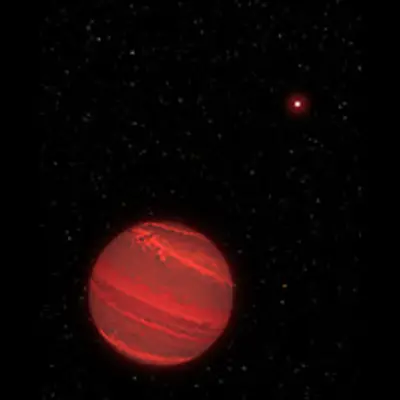
Artist's View of Planet Orbiting Twin Stars
This artist's illustration shows a gas giant planet circling a pair of red dwarf stars.The Saturn-mass planet orbits roughly 300 million miles from the stellar duo. The two red dwarf stars are a mere 7 million miles apart.The illustration is based on Hubble Space Telescope observ...
- Date
- Jan 1, 2016
- Mission
- Hubble Space Telescope
- Archive ID
- hubblesite-images-2016-32-3790-image

This artist's illustration shows a gas giant planet circling a pair of red dwarf stars.
The Saturn-mass planet orbits roughly 300 million miles from the stellar duo. The two red dwarf stars are a mere 7 million miles apart.
The illustration is based on Hubble Space Telescope observations that helped astronomers confirm the existence of a planet orbiting two stars in the system OGLE-2007-BLG-349, located 8,000 light-years away.
The system is too far away for Hubble to photograph the planet. Instead, its presence is inferred from gravitational microlensing. This phenomenon occurs when the gravity of a foreground star bends and amplifies the light of a background star that momentarily aligns with it. The particular character of the light magnification can reveal clues to the nature of the foreground star and any associated planets. The Hubble observations represent the first time such a three-body system has been confirmed using the gravitational microlensing technique.
Credits
NASA, ESA, and G. Bacon (STScI)Image Details
| About The Object | |
|---|---|
| Object Name | OGLE-2007-BLG-349, OGLE-2007-BLG-349L(AB)c |
| Object Description | Circumbinary Gravitational Microlensing Planet, Extrasolar Planet |
| R.A. Position | 18h 05m 24.76s |
| Dec. Position | -26° 25' 17.88" |
| Distance | 8,000 light-years |
| About The Data | |
| Data Description | Data were provided through HST proposal : A. Gould (Ohio State Univ.), D. Bennett (NASA GSFC, Univ. of Notre Dame), S. Dong (Ohio State Univ.), B. Gaudi (Harvard Univ.), R. Street (Las Cumbres Observ. Global Telescope Network), A. Udalski (Warsaw Univ.), and P. Yock (Univ. of Auckland). Principal Astronomer: D. Bennett (GSFC) Science team: D. Bennett (NASA GSFC; Univ. of Notre Dame; MOA Collaboration; and PLANET Collaboration), S. Rhie (Univ. of Notre Dame), A. Udalski (Warsaw Univ. Observ. and OGLE Collaboration), A. Gould (Ohio State Univ.; Max-Planck Inst. for Astronomy; Korea Astronomy and Space Science Institute; and FUN Collaboration), Y. Tsapras (Zentrum für Astronomie, Heidelberg; Las Cumbres Observ. Global Telescope Network; and Robonet Collaboration), D. Kubas (Institut d’Astrophysique de Paris, and PLANET Collaboration), L. Bond (Institute of Natural and Mathematical Sciences, and MOA Collaboration), J. Greenhill (Univ. of Tasmania, and PLANET Collaboration), A. Cassan (Institut d’Astrophysique de Paris, and PLANET Collaboration), N. Rattenbury (Univ. of Auckland, and MOA Collaboration), T. Boyajian (Nagoya Univ.), J. Luhn (Yale Univ.), M. Penny (Ohio State Univ.), F. Abe (Nagoya Univ.), A. Bhattacharya (Univ. of Notre Dame), C. Botzler, M. Donachie, and M. Freeman (Univ. of Auckland), A. Fukui (NAOJ), Y. Hirao (Osaka Univ.), Y. Itow (Nagoya Univ.), N. Koshimoto (Osaka Univ.), M. Li (Univ. of Auckland), C. Ling (Institut d’Astrophysique de Paris), K. Masuda, Y. Matsubara, and Y. Muraki (Nagoya Univ.), M. Nagakane (Osaka Univ.), K. Ohnishi (Nagano National College of Technology), H. Oyokawa (Nagoya Univ.), Y. Perrott (Univ. of Auckland), T. Saito (Tokyo Metropolitan College of Aeronautics), A. Sharan (Univ. of Auckland), D. Sullivan (Victoria Univ.), T. Sumi (Osaka Univ.), D. Suzuki (NASA GSFC, and Univ. of Notre Dame), P. Tristram (Mt. John Univ. Observ.), A. Yonehara (Kyoto Sangyo Univ.), P. Yock (Univ. of Auckland), M. Szymanski, I. Soszynski, K. Ulaczyk, and L. Wyrzykowski (Warsaw Univ. Observ.), W. Allen (Vintage Lane Observ.), D. DePoy (Texas A&M Univ.), A. Gal-Yam (Weizmann Inst. of Science), B. Gaudi (Ohio State Univ.), I. Monard (Bronberg and Kleinkaroo Observ.), E. Ofek (Weizmann Inst. of Science), R. Pogge (Ohio State Univ.), R. Street (Las Cumbres Observ. Global Telescope Network), D. Bramich (Qatar Environment and Energy Research Inst.), M. Dominik and K. Horne (SUPA), C. Snodgrass (Open Univ.), I. Steele (Liverpool John Moores Univ.), M. Albrow (Univ. of Canterbury), E. Bachelet (Las Cumbres Observ. Global Telescope), V. Batista and J.-P. Beaulieu (Institut d’Astrophysique de Paris), S. Brilliant (ESO Vitacura), J. Caldwell (McDonald Observ.), A. Cole (Univ. of Tasmania), C. Coutures (Institut d’Astrophysique de Paris), S. Dieters (Univ. of Tasmania), D. Dominis Prester (Univ. of Rieka), J. Donatowicz (Technical Univ. of Vienna), P. Fouqué (CFHT Corp., and IRAP/CNRS), M. Hundertmark (SUPA and Niels Bohr Inst.), U. Jørgensen (Niels Bohr Inst.), N. Kains (STScI), S. Kane (San Francisco State Univ.), J.-B. Marquette (Institut d’Astrophysique de Paris), J. Menzies (South African Astronomical Observ.), K. Pollard (Univ. of Canterbury), C. Ranc (Las Cumbres Observ. Global Telescope Network), K. Sahu (STScI), J. Wambsganss (Zentrum für Astronomie der Univ. Heidelberg), A. Williams (Perth Observ., and International Center for Radio Astronomy Research), and M. Zub (Zentrum für Astronomie der Univ. Heidelberg). |
| Instrument | HST>WFCP2 |
| Exposure Dates | Oct. 8, 2007, and May 4, 2008; Exposure Time: 1,600 seconds (total) |
| Filters | F814W and F555W |
Downloads
Source
Image and source material are credited to the official mission archive linked below.
View on NASA.gov