Hubble image archive
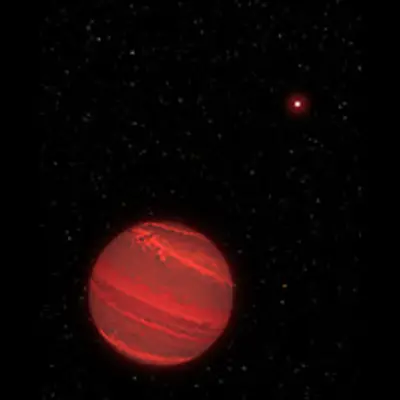
Artist's Concept of Makemake and Its Newly Discovered Moon (with title)
This artist's concept shows the distant dwarf planet Makemake and its newly discovered moon. Makemake and its moon, nicknamed MK 2, are more than 50 times farther away than Earth is from the sun. The pair resides in the Kuiper Belt, a vast reservoir of frozen material from the co...
- Date
- Jan 1, 2016
- Mission
- Hubble Space Telescope
- Archive ID
- hubblesite-images-2016-18-3741-image

This artist's concept shows the distant dwarf planet Makemake and its newly discovered moon. Makemake and its moon, nicknamed MK 2, are more than 50 times farther away than Earth is from the sun. The pair resides in the Kuiper Belt, a vast reservoir of frozen material from the construction of our solar system 4.5 billion years ago. Makemake is covered in bright, frozen methane that is tinted red by the presence of complex organic material. Its moon is too small to retain ices as volatile as methane, even given the feeble heating by the very distant sun, and likely has a much darker surface. MK 2 is orbiting 13,000 miles from the dwarf planet, and its estimated diameter is roughly 100 miles across. Makemake is 870 miles wide.
Credits
NASA, ESA, and A. Parker (Southwest Research Institute)Image Details
| About The Object | |
|---|---|
| Object Name | Makemake, Dwarf Planet (136472), Moon S/2015 (136472) 1, MK 2 |
| Object Description | Kuiper Belt Object, Dwarf Planet (136472) Makemake (870 miles in diameter) and moon S/2015 (136472) 1, MK 2 (100 miles in diameter) |
| R.A. Position | 12h 49m 39.0s |
| Dec. Position | 26° 22' 12.0" |
| About The Data | |
| Data Description | The HST data were taken from proposal PI: M. Buie (Southwest Research Institute), W. Grundy (Lowell Observatory), and K. Noll (NASA Goddard Space Flight Center). The science team comprises A. Parker and M. Buie (Southwest Research Institute), W. Grundy (Lowell Observatory), and K. Noll (NASA Goddard Space Flight Center). |
Downloads
Source
Image and source material are credited to the official mission archive linked below.
View on NASA.gov