Hubble image archive
Distant Galaxy GN-z11 in GOODS North Survey
Hubble Space Telescope astronomers, studying the northern hemisphere field from the Great Observatories Origins Deep Survey (GOODS), have measured the distance to the farthest galaxy ever seen. The survey field contains tens of thousands of galaxies stretching far back into time....
- Date
- Jan 1, 2016
- Mission
- Hubble Space Telescope
- Archive ID
- hubblesite-images-2016-07-3706-image

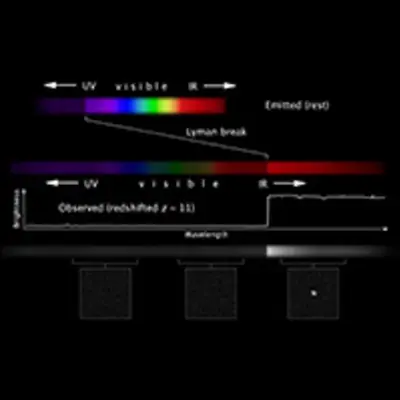
Hubble Space Telescope astronomers, studying the northern hemisphere field from the Great Observatories Origins Deep Survey (GOODS), have measured the distance to the farthest galaxy ever seen. The survey field contains tens of thousands of galaxies stretching far back into time. Galaxy GN-z11, shown in the inset, is seen as it was 13.4 billion years in the past, just 400 million years after the big bang, when the universe was only three percent of its current age. The galaxy is ablaze with bright, young, blue stars, but looks red in this image because its light has been stretched to longer spectral wavelengths by the expansion of the universe.
Credits
NASA, ESA, P. Oesch (Yale University), G. Brammer (STScI), P. van Dokkum (Yale University), and G. Illingworth (University of California, Santa Cruz)Image Details
| About The Object | |
|---|---|
| Object Name | GOODS North Survey, GN-z11 |
| Object Description | Farthest Galaxy Candidate from CANDELS/GOODS-N Field |
| R.A. Position | 12h 36m 54.99s |
| Dec. Position | 62° 14' 15.0" |
| Constellation | Ursa Major |
| About The Data | |
| Data Description | Recent data were obtained from the HST proposal , PI: P. Oesch (Yale University), G. Illingworth (University of California, Santa Cruz), I. Labbé (Leiden University), G. Brammer (STScI), R. Bouwens and M. Franx (Leiden University), P. van Dokkum (Yale University), D. Magee (UCO/Lick Observatory/University of California, Santa Cruz), I. Momcheva (Harvard-Smithsonian Center for Astrophysics), R. Smit (Durham University), M. Ashby, G. Fazio, J. Huang, and S. Willner (Harvard-Smithsonian Center for Astrophysics), V. Gonzalez (University of California, Riverside), R. Skelton (South African Astronomical Observatory), M. Trenti (University of Melbourne), and L. Spitler (Macquarie University/Australian Astronomical Observatory). The science team includes: P. Oesch (Yale University), G. Brammer (STScI), P. van Dokkum (Yale University), G. Illingworth (University of California, Santa Cruz), R. Bouwens, I. Labbé, and M. Franx (Leiden University), I. Momcheva, M. Ashby, and G. Fazio (Harvard-Smithsonian Center for Astrophysics), V. Gonzalez (University of California, Riverside), B. Holden and D. Magee (UCO/Lick Observatory/University of California, Santa Cruz), R. Skelton (South African Astronomical Observatory), R. Smit (Durham University), L. Spitler (Macquarie University/Australian Astronomical Observatory), M. Trenti (University of Melbourne), and S. Willner (Harvard-Smithsonian Center for Astrophysics). |
| Instrument | HST>ACS/WFC, and HST>WFC3/IR |
| Exposure Dates | February 11, 2015, and April 3, 2015 |
| Filters | Main CANDELS/GOODS-N Field: HST>ACS/WFC: F435W (B), F606W (V), F814W (I), and F850LP (z), and HST> WFC3/IR: F105W (Y), F125W (J), and F160W (H) Grism Data (February 11, 2015, and April 3, 2015): HST>WFC3/IR: G141 |
| About The Image | |
| Color Info | The main GOODS-N composite includes exposures acquired by the ACS and WFC3 instruments on the Hubble Space Telescope. Several filters were used to sample broad wavelength ranges. The color results from assigning different hues (colors) to each monochromatic (grayscale) image associated with an individual filter. In this case, the assigned colors are: Blue: F435W (B) + F606W (V) Green: F814W (I) + F850LP (z) Red: F125W (J) + F160W (H) |
Downloads
Source
Image and source material are credited to the official mission archive linked below.
View on NASA.gov