Hubble image archive
Distant Active Comet C/2017 K2
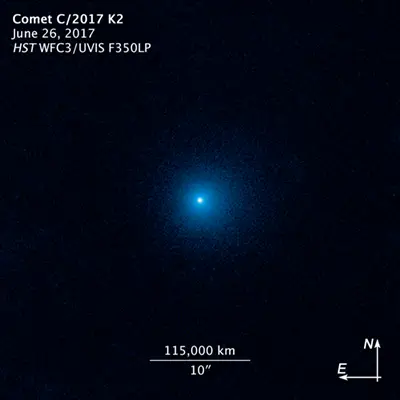
Hubble Uncovers the Farthest Active Inbound Comet Yet SeenThis Hubble Space Telescope image shows a fuzzy cloud of dust, called a coma, surrounding the comet C/2017 K2 PANSTARRS (K2), the farthest active comet ever observed entering the solar system.Hubble snapped images of K2 wh...
- Date
- Jan 1, 2017
- Mission
- Hubble Space Telescope
- Archive ID
- hubblesite-images-2017-40-4069-image

Hubble Uncovers the Farthest Active Inbound Comet Yet Seen
This Hubble Space Telescope image shows a fuzzy cloud of dust, called a coma, surrounding the comet C/2017 K2 PANSTARRS (K2), the farthest active comet ever observed entering the solar system.
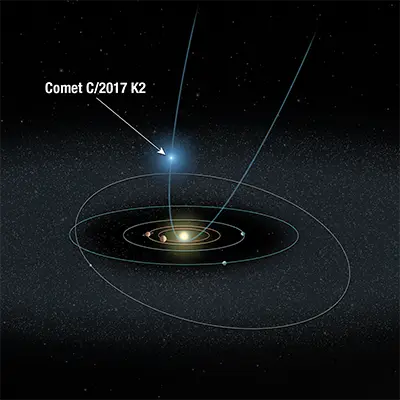
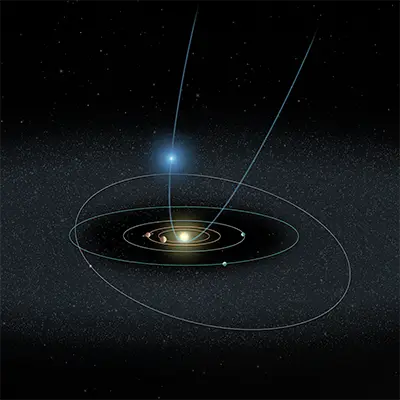
Hubble snapped images of K2 when the frozen visitor was 1.5 billion miles from the Sun, just beyond Saturn's orbit. Even at that remote distance, sunlight is warming the frigid comet, producing an 80,000-mile-wide coma that envelops a tiny, solid nucleus.
K2 has been traveling for millions of years from its home in the Oort Cloud, a spherical region at the edge of our solar system. This frigid area contains hundreds of billions of comets, the icy leftovers from the formation of the solar system 4.6 billion years ago.
The image was taken in June 2017 by Hubble's Wide Field Camera 3.
Credits
NASA, ESA, and D. Jewitt (UCLA)Image Details
| About The Object | |
|---|---|
| Object Name | C/2017 K2 |
| Object Description | Primordial comet |
| R.A. Position | 17 31 52.239 |
| Dec. Position | +64 35 39.52 |
| Distance | 15.82AU at the time of observation |
| Dimensions | The image is about 40 arcseconds across, about 16.3 million miles (26.3 million kilometers) at the distance of the comet. |
| About The Data | |
| Data Description | Data were provided by the HST proposals (D. Jewett, P.I.). |
| Instrument | WFC3/UVIS |
| Exposure Dates | June 27, 2017 |
| Filters | F350LP |
| About The Image | |
| Color Info | These images represent several exposures acquired by the WFC3/UVIS instrument through the F350LP filter on the Hubble Space Telescope. Color has been applied to the grayscale (black&white) images; the brightness maps to different color values. |
Source
Image and source material are credited to the official mission archive linked below.
View on NASA.gov