Hubble image archive
Hubble Images 30 Doradus: NGC 2060
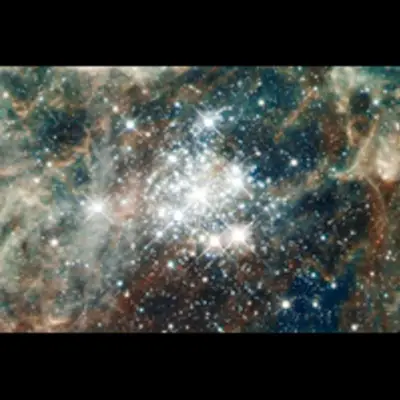
The star cluster NGC 2060 is a loose collection of stars that are no longer gravitationally bound to each other. The stellar grouping will disperse in a few million years. It contains a supernova that exploded about 10,000 years ago, blowing out gas surrounding it. The dark regio...
- Date
- Jan 1, 2012
- Mission
- Hubble Space Telescope
- Archive ID
- hubblesite-images-2012-01-2944-image

The star cluster NGC 2060 is a loose collection of stars that are no longer gravitationally bound to each other. The stellar grouping will disperse in a few million years. It contains a supernova that exploded about 10,000 years ago, blowing out gas surrounding it. The dark region below the cluster is a dense cloud of dust lying in front of it.
30 Doradus is the brightest, nearby star-forming region and home to the most massive stars in our cosmic neighborhood of about 25 galaxies. The nebula is close enough to Earth that Hubble can resolve individual stars, giving astronomers important information about the stars' birth and evolution. 30 Doradus resides 170,000 light-years away in the Large Magellanic Cloud, a small, satellite galaxy of our Milky Way.
Credits
NASA, ESA, D. Lennon and E. Sabbi (ESA/STScI), J. Anderson, S. E. de Mink, R. van der Marel, T. Sohn, and N. Walborn (STScI), N. Bastian (Excellence Cluster, Munich), L. Bedin (INAF, Padua), E. Bressert (ESO), P. Crowther (University of Sheffield), A. de Koter (University of Amsterdam), C. Evans (UKATC/STFC, Edinburgh), A. Herrero (IAC, Tenerife), N. Langer (AifA, Bonn), I. Platais (JHU), and H. Sana (University of Amsterdam)Image Details
| About The Object | |
|---|---|
| Object Name | Tarantula Nebula, 30 Doradus, 30 Dor, NGC 2070 |
| Object Description | Emission Nebula in the Large Magellanic Cloud |
| R.A. Position | 05h 38m 42.36s |
| Dec. Position | -69° 6' 3.24" |
| Constellation | Dorado |
| Distance | Approximately 170,000 light-years (52,000 parsecs) |
| About The Data | |
| Data Description | This image combines many exposures from the Hubble Space Telescope's Advanced Camera for Surveys (ACS) and Wide Field Camera 3 (WFC3) from the HST proposal : D. Lennon and E. Sabbi (ESA/STScI), J. Anderson, S. E. de Mink, R. van der Marel, T. Sohn, and N. Walborn (STScI), N. Bastian (Excellence Cluster, Munich), L. Bedin (INAF, Padua), E. Bressert (ESO), P. Crowther (University of Sheffield), A. de Koter (University of Amsterdam), C. Evans (UKATC/STFC, Edinburgh), A. Herrero (IAC, Tenerife), N. Langer (AifA, Bonn), I. Platais (JHU), and H. Sana (University of Amsterdam). |
| Instrument | HST>ACS/WFC, HST>WFC3/UVIS, and ESO 2.2m Telescope>WFI |
| Exposure Dates | October 2011 (HST), and January 2006 (ESO) |
| Filters | ACS/WFC and WFC3/UVIS: F775W (SDSS i) ESO: OIII/8 and H-alpha/7 |
| About The Image | |
| Color Info | This image is a composite of many separate exposures made by the ACS and WFC3 instruments on the Hubble Space Telescope along with ESO 2.2m ground-based observations. In total, two filters were used to sample narrow wavelength emission and two filters were used to sample broadband wavelengths. The color results from assigning different hues (colors) to each monochromatic image. In this case, the assigned colors are: Red: ESO H-alpha (656nm) Green: ESO average of H-alpha+[O III] Blue: ESO [O III] (502nm) Luminosity*: ACS/WFC F775W + WFC3/UVIS F775W * The higher-resolution, black & white Hubble image and the lower-resolution, color ESO images were combined using a technique that takes luminosity (brightness) information from the black and white ACS/WFC3 image and color information from the composite ESO image. This preserves all of the higher-resolution detail from the Hubble data while rendering a color image representing the physical processes in this active region of space. |
More Images From This Period
Downloads
Source
Image and source material are credited to the official mission archive linked below.
View on NASA.gov