Hubble image archive
Overlapping Galaxies 2MASX J00482185-2507365
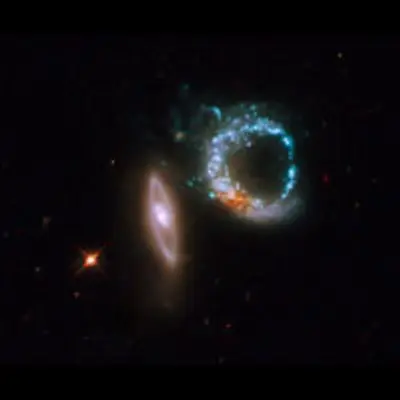
NASA's Hubble Space Telescope has captured a rare alignment between two spiral galaxies. The outer rim of a small, foreground galaxy is silhouetted in front of a larger background galaxy. Skeletal tentacles of dust can be seen extending beyond the small galaxy's disk of starlight...
- Date
- Jan 1, 2008
- Mission
- Hubble Space Telescope
- Archive ID
- hubblesite-images-2008-33-2403-image

NASA's Hubble Space Telescope has captured a rare alignment between two spiral galaxies. The outer rim of a small, foreground galaxy is silhouetted in front of a larger background galaxy. Skeletal tentacles of dust can be seen extending beyond the small galaxy's disk of starlight.
Such outer dark dusty structures, which appear to be devoid of stars, like barren branches, are rarely so visible in a galaxy because there is usually nothing behind them to illuminate them. Astronomers have never seen dust this far beyond the visible edge of a galaxy. They do not know if these dusty structures are common features in galaxies.
Understanding a galaxy's color and how dust affects and dims that color are crucial to measuring a galaxy's true brightness. By knowing the true brightness, astronomers can calculate the galaxy's distance from Earth.
Astronomers calculated that the background galaxy is 780 million light-years away. They have not as yet calculated the distance between the two galaxies, although they think the two are relatively close, but not close enough to interact. The background galaxy is about the size of the Milky Way Galaxy and is about 10 times larger than the foreground galaxy.
Most of the stars speckled across this image belong to the nearby spiral galaxy NGC 253, which is out of view to the right. Astronomers used Hubble's Advanced Camera for Surveys to snap images of NGC 253 when they spied the two galaxies in the background. From ground-based telescopes, the two galaxies look like a single blob. But the Advanced Camera's sharp "eye" distinguished the blob as two galaxies, cataloged as 2MASX J00482185-2507365. The images were taken on Sept. 19, 2006.
The results have been submitted for publication in The Astronomical Journal.
Credits
NASA, ESA, and The Hubble Heritage Team (STScI/AURA);Acknowledgment: B. Holwerda (Space Telescope Science Institute) and J. Dalcanton (University of Washington)
Image Details
| About The Object | |
|---|---|
| Object Name | 2MASX J00482185-2507365 |
| Object Description | Overlapping Galaxies |
| R.A. Position | 14h 13m 10.04s |
| Dec. Position | -65° 20' 44.8" |
| Constellation | Sculptor |
| Distance | 780 million light-years (240 megaparsecs) |
| Dimensions | This image is roughly 50 arcseconds (180,000 light-years or 56 kiloparsecs) wide. |
| About The Data | |
| Data Description | HST Proposal: J. Dalcanton (University of Washington) et al. The science team comprises B. Holwerda and R. de Jong (Space Telescope Science Institute), W. Keel (University of Alabama, Tuscaloosa), and J. Dalcanton and B. Williams (University of Washington). |
| Instrument | HST>ACS/WFC |
| Exposure Dates | September 19, 2006, Exposure Time: 1.9 hours |
| Filters | F475W (B), F606W (V), and F814W (I) |
| About The Image | |
| Color Info | The image is a composite of separate exposures made by the ACS instrument on the Hubble Space Telescope. Three filters were used to sample broad wavelength ranges. The color results from assigning different hues (colors) to each monochromatic image. In this case, the assigned colors are: Blue: F475W (B) Green: F606W (V) Red: F814W (I) |
More Images From This Period
Downloads
Source
Image and source material are credited to the official mission archive linked below.
View on NASA.gov