Hubble image archive
Hubble Probes Comet 103P/Hartley 2 in Preparation for DIXI/EPOXI Flyby
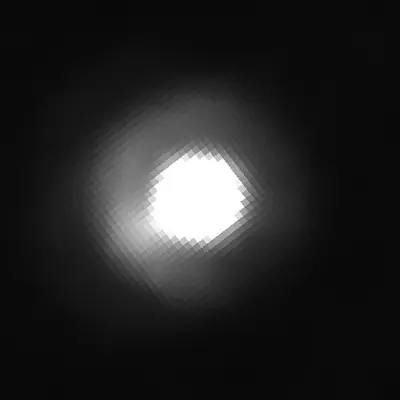
Hubble Space Telescope observations of comet 103P/Hartley 2, taken on September 25, are helping in the planning for a November 4 flyby of the comet by NASA's Deep Impact eXtended Investigation (DIXI) on NASA's Deep Impact Spacecraft performing the EPOXI mission.Analysis of the ne...
- Date
- Jan 1, 2010
- Mission
- Hubble Space Telescope
- Archive ID
- hubblesite-images-2010-35-2793-image

Hubble Space Telescope observations of comet 103P/Hartley 2, taken on September 25, are helping in the planning for a November 4 flyby of the comet by NASA's Deep Impact eXtended Investigation (DIXI) on NASA's Deep Impact Spacecraft performing the EPOXI mission.
Analysis of the new Hubble data shows that the nucleus has a diameter of approximately 0.93 miles (1.5 kilometers), which is consistent with previous estimates.
Credits
NASA, ESA, and H. Weaver (The Johns Hopkins University/Applied Physics Lab)Image Details
| About The Object | |
|---|---|
| Object Name | Comet 103/P Hartley 2 |
| Object Description | Comet |
| Distance | At the time of the Hubble observation, the comet was 1.153 astronomical units (172 million km or 107 million miles) from the Sun. The comet was 0.218 astronomical units (32.6 million km or 20.2 million miles) from Earth. |
| About The Data | |
| Data Description | This image was created from HST data from proposal : H. Weaver (JHU/APL), M. A’Hearn (University of Maryland, College Park), N. Dello Russo (JHU/APL), P. Feldman (Johns Hopkins University), and S.A. Stern (Southwest Research Institute) |
| Instrument | HST>STIS/CCD |
| Exposure Dates | Sept. 25, 2010 |
| Filters | F28x50LP |
| About The Image | |
| Color Info | This image was originally black and white and recorded only overall brightness. These brightness values were translated into a range of bluish hues. Such color "maps" can be useful in helping to distinguish subtly varying brightness in an image. |
Downloads
Source
Image and source material are credited to the official mission archive linked below.
View on NASA.gov