Hubble image archive
Trans-Neptunian Object
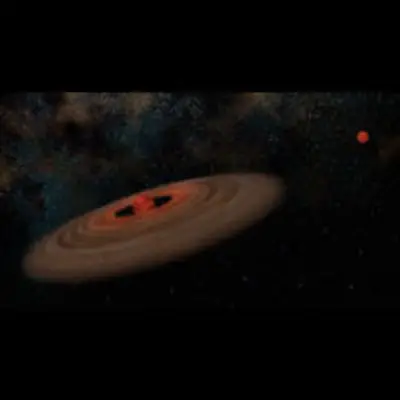
This is an artist's concept of a craggy piece of solar system debris that belongs to a class of bodies called trans-Neptunian objects (TNOs). Most TNOs are small and faint, making them difficult to spot. Generally, they are more than 100 million times fainter than objects visible...
- Date
- Jan 1, 2010
- Mission
- Hubble Space Telescope
- Archive ID
- hubblesite-images-2010-32-2771-image

This is an artist's concept of a craggy piece of solar system debris that belongs to a class of bodies called trans-Neptunian objects (TNOs). Most TNOs are small and faint, making them difficult to spot. Generally, they are more than 100 million times fainter than objects visible to the unaided eye. The newfound TNOs range from 25 to 60 miles (40-100 km) across. In this illustration, the distant Sun is reduced to a bright star at a distance of over 3 billion miles. Astronomers culling the data archives of NASA's Hubble Space Telescope have added 14 new TNOs to the catalog. Their search method promises to turn up hundreds more.
Credits
Artwork: NASA, ESA, and G. Bacon (STScI);Science: NASA, ESA, and C. Fuentes (Harvard-Smithsonian Center for Astrophysics)
Image Details
| About The Object | |
|---|---|
| Object Description | Trans-Neptunian Objects |
| About The Data | |
| Data Description | The science team includes: C. Fuentes, M. Holman, and P. Protopapas (Harvard-Smithsonian Center for Astrophysics) and D. Trilling (Northern Arizona University). The datasets used in this release are from the following HST proposals: , , , , , , , , , , and . |
| Instrument | HST>ACS/WFC |
Downloads
Source
Image and source material are credited to the official mission archive linked below.
View on NASA.gov