Hubble image archive
Upsilon Andromedae A System
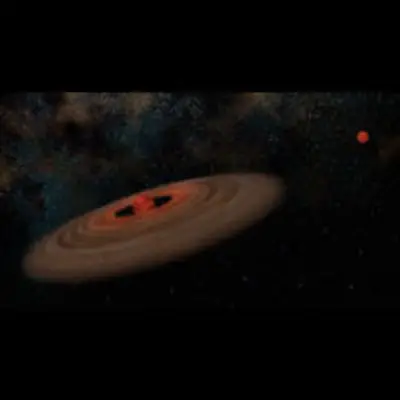
This is an artist's illustration of the Upsilon Andromedae A planetary system, where three Jupiter-type planets orbit the yellow-white star Upsilon Andromedae A. Astronomers have recently discovered that not all planets orbit this star in the same plane, as the major planets in o...
- Date
- Jan 1, 2010
- Mission
- Hubble Space Telescope
- Archive ID
- hubblesite-images-2010-17-2734-image

This is an artist's illustration of the Upsilon Andromedae A planetary system, where three Jupiter-type planets orbit the yellow-white star Upsilon Andromedae A. Astronomers have recently discovered that not all planets orbit this star in the same plane, as the major planets in our solar system orbit the Sun. The orbits of two of the planets are inclined by 30 degrees with respect to each other. Such a strange orientation has never before been seen in any other planetary system. This surprising finding will impact theories of how planetary systems form and evolve, say researchers. It suggests that some violent events can happen to disrupt planets' orbits after a planetary system forms. The discovery was made by joint observations with the Hubble Space Telescope, the Hobby-Eberly Telescope, and other ground-based telescopes.
Credits
Illustration: NASA, ESA, and A. Feild (STScI);Science: NASA, ESA, and B. McArthur (The University of Texas at Austin, McDonald Observatory)
Image Details
| About The Object | |
|---|---|
| Object Name | Upsilon Andromedae |
| Object Description | Star with Planetary System |
| R.A. Position | 01h 36m 47s.76 |
| Dec. Position | +41° 24' 18".9 |
| Constellation | Andromeda |
| Distance | 44 light-years (13.6 parsecs) |
| About The Data | |
| Data Description | The Hubble data are from the HST proposals , , and : G. Benedict and B. McArthur (University of Texas, Austin), E. Nelan (STScI), M. McGrath (NASA/MSFC), P. Butler (Carnegie Institution of Washington), G. Marcy (University of California, Berkeley), A. Hatzes (Tautenburg Observatory, Germany), B. Cochran (University of Texas, Austin), and G. Gatewood (University of Pittsburgh). Note: The discovery was made by joint observations from the Hubble Space Telescope, the Hobby-Eberly Telescope (HET), and other ground-based telescopes. The Hobby-Eberly Telescope is located at the University of Texas at Austin's McDonald Observatory. Spectroscopic observations of the Upsilon Andromedae system were taken with the HET's High Resolution Spectrograph from August 2004 through July 2008. |
| Instrument | HST>FGS |
| Exposure Dates | December 2001 - August 2006 |
| Filters | F5ND and F583W |
Downloads
Source
Image and source material are credited to the official mission archive linked below.
View on NASA.gov