Hubble image archive
Aristarchus Crater in False Color
This color composite focuses on the 26-mile-diameter (42-kilometer-diameter) Aristarchus impact crater, and employs ultraviolet- to visible-color-ratio information to accentuate differences that are potentially diagnostic of ilmenite- (i.e, titanium oxide) bearing materials as we...
- Date
- Jan 1, 2005
- Mission
- Hubble Space Telescope
- Archive ID
- hubblesite-images-2005-29-1775-image
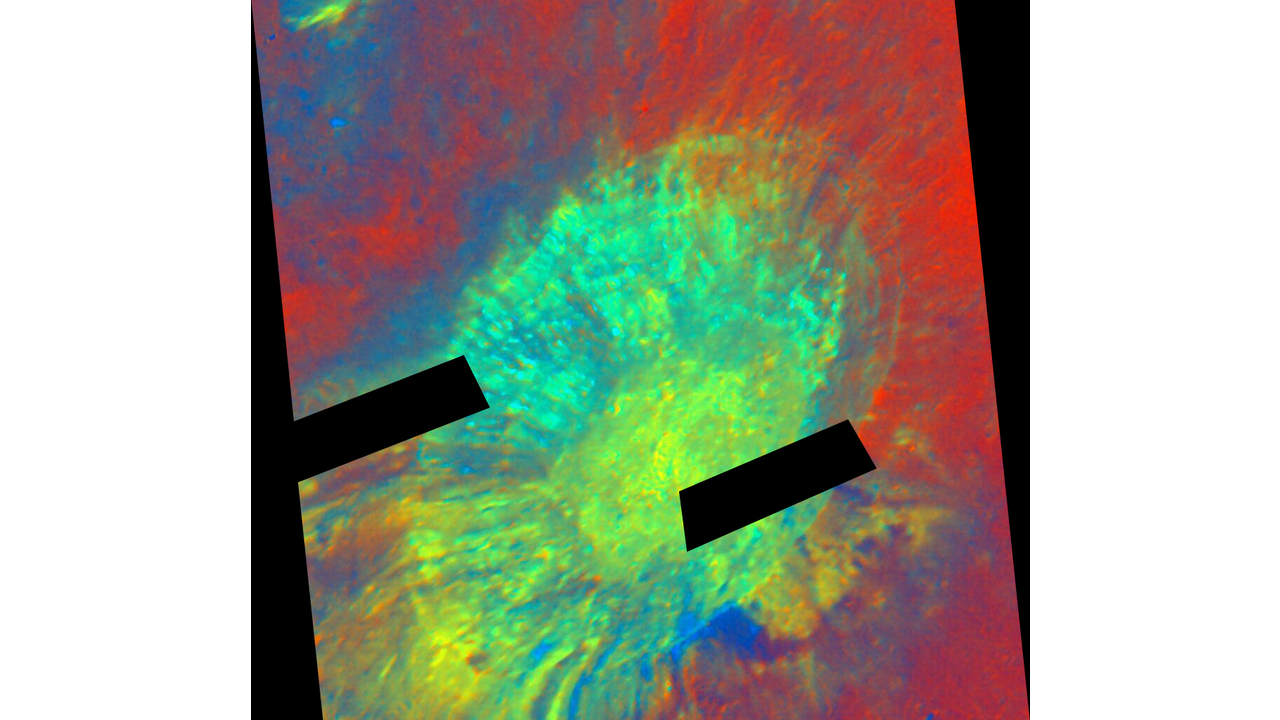
This color composite focuses on the 26-mile-diameter (42-kilometer-diameter) Aristarchus impact crater, and employs ultraviolet- to visible-color-ratio information to accentuate differences that are potentially diagnostic of ilmenite- (i.e, titanium oxide) bearing materials as well as pyroclastic glasses. The symphony of color within the Aristarchus crater clearly shows a diversity of materials - anorthosite, basalt, and olivine. The images were acquired Aug. 21, 2005. The processing was accomplished by the Hubble Space Telescope Lunar Exploration Team at NASA's Goddard Space Flight Center, Northwestern University, and the Space Telescope Science Institute. False-color images were constructed using the red channel as 502/250 nanometers; the green as 502 nanometers; and the blue as 250/658 nanometers. North is at the top in the image.
Credits
NASA, ESA, and J. Garvin (NASA/GSFC)Image Details
| About The Object | |
|---|---|
| Object Name | moon |
| Object Description | Earth's Satellite |
| Distance | The Moon is 238,857 miles (384,403 kilometers) from the Earth. |
| Dimensions | The Moon has a diameter of 2160 miles (3476 kilometers). |
| About The Data | |
| Data Description | These HST data are from proposal . NASA's HST Lunar observation team is led by Chief Scientist J. Garvin. The team includes M. Robinson (Northwestern Univ.), D. Skillman (NASA/GSFC), B. Hapke (Univ. of Pittsburgh), C. Pieters (Brown Univ.), M. Ulmer (Northwestern Univ.), J. Bell (Cornell Univ.), and J. Taylor (Univ. of Hawaii). |
| Instrument | HST>ACS/HRC |
| Exposure Dates | August 21, 2005 |
| Filters | F250W (250nm), F344N (344nm), F502N (502nm), F658N (658nm) |
More Images From This Period
Downloads
Source
Image and source material are credited to the official mission archive linked below.
View on NASA.gov