Hubble image archive
Hubble's Latest Views of Light Echo from Star V838 Monocerotis
These are the most recent NASA Hubble Space Telescope views of an unusual phenomenon in space called a light echo. Light from a star that erupted nearly five years ago continues propagating outward through a cloud of dust surrounding the star. The light reflects or "echoes" off t...
- Date
- Jan 1, 2006
- Mission
- Hubble Space Telescope
- Archive ID
- hubblesite-images-2006-50-2005-image
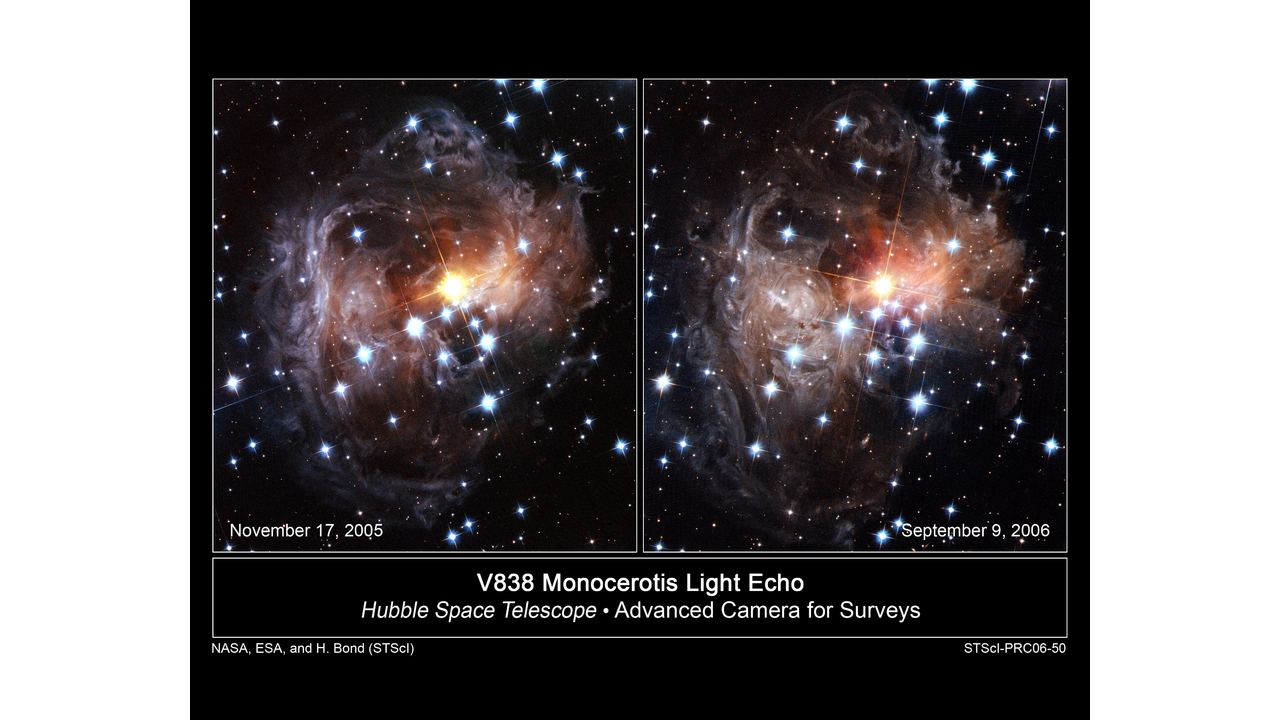
These are the most recent NASA Hubble Space Telescope views of an unusual phenomenon in space called a light echo. Light from a star that erupted nearly five years ago continues propagating outward through a cloud of dust surrounding the star. The light reflects or "echoes" off the dust and then travels to Earth.
Because of the extra distance the scattered light travels, it reaches the Earth long after the light from the stellar outburst itself. Therefore, a light echo is an analog of a sound echo produced, for example, when sound from an Alpine yodeler echoes off of the surrounding mountainsides.
The echo comes from the unusual variable star V838 Monocerotis (V838 Mon), located 20,000 light-years away on the periphery of our Galaxy. In early 2002, V838 Mon increased in brightness temporarily to become 600,000 times brighter than our Sun. The reason for the eruption is still unclear.
Hubble has been observing the V838 Mon light echo since 2002. Each new observation of the light echo reveals a new and unique "thin-section" through the interstellar dust around the star. The new images of the light echo were taken with Hubble's Advanced Camera for Surveys in November 2005 (left) and September 2006 (right). Particularly noticeable in the images are numerous whorls and eddies in the interstellar dust, which are possibly produced by effects of magnetic fields.
Credits
NASA, ESA, and H. Bond (STScI)Image Details
| About The Object | |
|---|---|
| Object Name | V838 Monocerotis, V838 Mon |
| Object Description | Nova-like variable star and surrounding light echo |
| R.A. Position | 07h 4m 4.99s |
| Dec. Position | -3° 50' 50.0" |
| Constellation | Monoceros |
| Distance | The star is ~20,000 light-years (~6 kiloparsecs) away. |
| Dimensions | 2.5 arcminutes (14 light-years or 4.5 parsecs) wide |
| About The Data | |
| Data Description | This image was created from HST data from the following proposals: and : H. Bond (STScI), R. Wagner (University of Arizona), R. White (STScI), R. Corradi (Observatorio del Roque de los Muchachos), L. Crause (University of Cape Town), M. Dopita (Australian National University), A. Henden (United States Naval Observatory), Z. Levay (STScI), U. Munari (Universita di Padova), N. Panagia (STScI/ESA), W. Sparks (STScI), S. Starrfield (Arizona State University), and B. Sugerman (STScI). |
| Instrument | HST>ACS/WFC |
| Exposure Dates | November 17, 2005 (left) and September 9, 2006 (right) |
| Filters | F606W (V) and F814W (I) |
| About The Image | |
| Color Info | This image is a composite of many separate exposures made by the ACS instrument on the Hubble Space Telescope. Two filters were used to sample broad wavelength ranges. The color results from assigning different hues (colors) to each monochromatic image. In this case, the assigned colors are: Blue: F606W (V) Greed: F606W (V) + F814W (I) Red: F814W (I) |
Downloads
Source
Image and source material are credited to the official mission archive linked below.
View on NASA.gov