Hubble image archive
Intergalactic Absorbtion Clouds
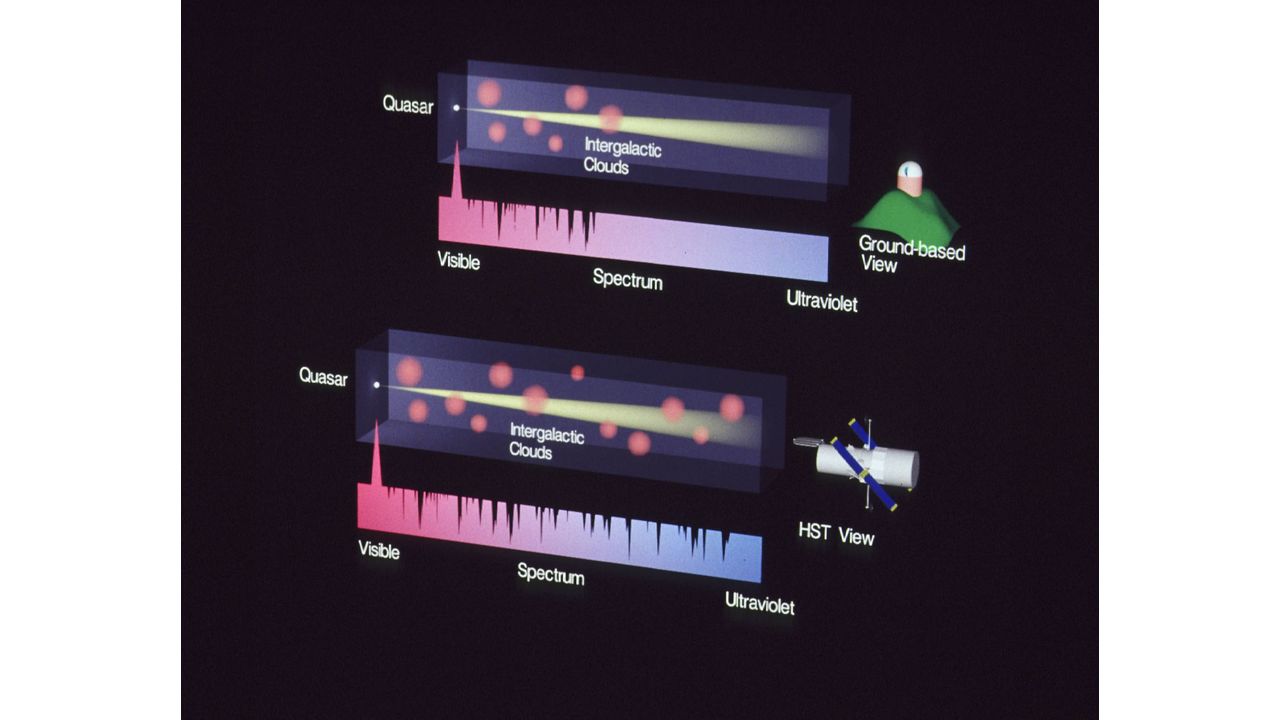
[Top Diagram] The transparent block schematically represents a column of space between a distant quasar and a telescope on earth. As the quasar's light travels across space, invisible, intervening clouds of hydrogen gas absorb certain frequencies of the light. This creates comple...
- Date
- Jan 1, 1992
- Mission
- Hubble Space Telescope
- Archive ID
- hubblesite-images-1992-04-54-image
[Top Diagram]
The transparent block schematically represents a column of space between a distant quasar and a telescope on earth. As the quasar's light travels across space, invisible, intervening clouds of hydrogen gas absorb certain frequencies of the light. This creates complex "thickets" of absorption features, schematically shown in the spectrum below the box. Ground-based observations have shown that the number of these clouds rapidly rises as one looks back in time.
[Bottom Diagram]
Hubble Space Telescope dramatically changed this picture in 1991 when independent observations made with the HST's Faint Object Spectrograph (OS) and Goddard High Resolution Spectrograph (GHRS) detected more than a dozen hydrogen clouds within less than a billion light-years of our galaxy. Until the launch of HST, it was impossible detect these clouds because the recession velocity of the nearby clouds is so low that the hydrogen absorption features occur in the far ultraviolet part of the spectrum, which is inaccessible with ground-based telescopes.
New HST observations show that some absorption lines are more clumped together than thought previously. A few of the lines can be directly associated with galaxies that lie along the line of sight to the quasar. This suggests that the material producing the nearby hydrogen absorption may be associated with individual galaxies or clusters of galaxies.
Credits
STScI Astronomy Visualization Laboratory
Downloads
Source
Image and source material are credited to the official mission archive linked below.
View on NASA.gov