Hubble image archive
Blobs in Space: the Legacy of Nova T Pyxidis
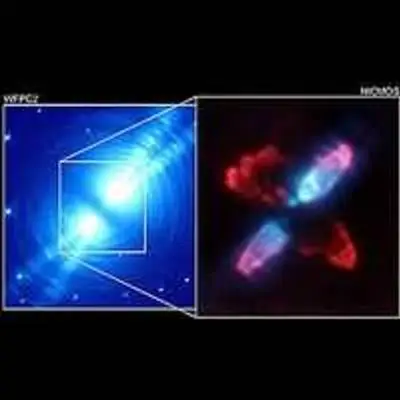
The prolific number of eruptions by the recurrent nova T Pyxidis has attracted the attention of many telescopes.[LEFT] The image on the left, taken by a ground-based telescope, shows shells of gas around the star that were blown off during several eruptions.[RIGHT] Closer inspect...
- Date
- Jan 1, 1997
- Mission
- Hubble Space Telescope
- Archive ID
- hubblesite-images-1997-29-513-image

The prolific number of eruptions by the recurrent nova T Pyxidis has attracted the attention of many telescopes.
[LEFT]
The image on the left, taken by a ground-based telescope, shows shells of gas around the star that were blown off during several eruptions.
[RIGHT]
Closer inspection by the Hubble Space Telescope (right-hand image), however, reveals that the shells are not smooth at all. In fact, this high-resolution image shows that the shells are actually more than 2,000 gaseous blobs packed into an area that is 1 light-year across. Resembling shrapnel from a shotgun blast, the blobs may have been produced by the nova explosion, the subsequent expansion of gaseous debris, or collisions between fast-moving and slow- moving gas from several eruptions. False color has been applied to this image to enhance details in the blobs.
The ground-based image was taken Jan. 19, 1995 by the European Southern Observatory's New Technology Telescope in La Silla, Chile. The Hubble telescope picture is a compilation of data taken on Feb. 26, 1994, and June 16, Oct. 7, and Nov. 10, 1995, by the Wide Field and Planetary Camera 2.
T Pyxidis is 6,000 light-years away in the dim southern constellation Pyxis, the Mariner's Compass.
Credits
Mike Shara, Bob Williams, and David Zurek (Space Telescope Science Institute); Roberto Gilmozzi (European Southern Observatory); Dina Prialnik (Tel Aviv University); and NASAImage Details
| About The Object | |
|---|---|
| Object Name | T Pyxidis |
| R.A. Position | 09h 4m 41.47s |
| Dec. Position | -32° 22' 46.99" |
Downloads
Source
Image and source material are credited to the official mission archive linked below.
View on NASA.gov