Hubble image archive
Cone Nebula (NGC 2264): Star-Forming Pillar of Gas and Dust
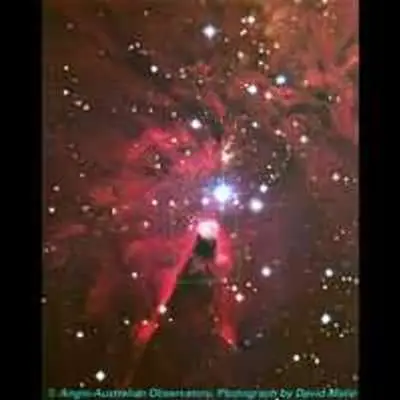
Resembling a nightmarish beast rearing its head from a crimson sea, this monstrous object is actually an innocuous pillar of gas and dust. Called the Cone Nebula (NGC 2264) - so named because, in ground-based images, it has a conical shape - this giant pillar resides in a turbule...
- Date
- Jan 1, 2002
- Mission
- Hubble Space Telescope
- Archive ID
- hubblesite-images-2002-11-1189-image

Resembling a nightmarish beast rearing its head from a crimson sea, this monstrous object is actually an innocuous pillar of gas and dust. Called the Cone Nebula (NGC 2264) - so named because, in ground-based images, it has a conical shape - this giant pillar resides in a turbulent star-forming region.
This picture, taken by the newly installed Advanced Camera for Surveys (ACS) aboard NASA's Hubble Space Telescope, shows the upper 2.5 light-years of the nebula, a height that equals 23 million roundtrips to the Moon. The entire nebula is 7 light-years long. The Cone Nebula resides 2,500 light-years away in the constellation Monoceros.
Radiation from hot, young stars [located beyond the top of the image] has slowly eroded the nebula over millions of years. Ultraviolet light heats the edges of the dark cloud, releasing gas into the relatively empty region of surrounding space. There, additional ultraviolet radiation causes the hydrogen gas to glow, which produces the red halo of light seen around the pillar. A similar process occurs on a much smaller scale to gas surrounding a single star, forming the bow-shaped arc seen near the upper left side of the Cone. This arc, seen previously with the Hubble telescope, is 65 times larger than the diameter of our solar system. The blue-white light from surrounding stars is reflected by dust. Background stars can be seen peeking through the evaporating tendrils of gas, while the turbulent base is pockmarked with stars reddened by dust.
Over time, only the densest regions of the Cone will be left. Inside these regions, stars and planets may form.
The Cone Nebula is a cousin of the M16 pillars, which the Hubble telescope imaged in 1995. Monstrous pillars of cold gas, like the Cone and M16, are common in large regions of star birth. Astronomers believe that these pillars are incubators for developing stars.
ACS made this observation on April 2, 2002. The color image is constructed from three separate images taken in blue, near-infrared, and hydrogen-alpha filters.
Credits
NASA, H. Ford (JHU), G. Illingworth (UCSC/LO), M.Clampin (STScI), G. Hartig (STScI), the ACS Science Team, and ESA;The ACS Science Team: H. Ford, G. Illingworth, M. Clampin, G. Hartig, T. Allen, K. Anderson, F. Bartko, N. Benitez, J. Blakeslee, R. Bouwens, T. Broadhurst, R. Brown, C. Burrows, D. Campbell, E. Cheng, N. Cross, P. Feldman, M. Franx, D. Golimowski, C. Gronwall, R. Kimble, J. Krist, M. Lesser, D. Magee, A. Martel, W. J. McCann, G. Meurer, G. Miley, M. Postman, P. Rosati, M. Sirianni, W. Sparks, P. Sullivan, H. Tran, Z. Tsvetanov, R. White, and R. Woodruff.
Image Details
| About The Object | |
|---|---|
| Object Name | Cone Nebula, NGC 2264 |
| Object Description | Gaseous Pillar in the Milky Way Galaxy |
| R.A. Position | 06h 41m 6.0s |
| Dec. Position | 09° 52' 59.99" |
| Constellation | Monoceros |
| Distance | About 2,500 light-years (770 parsecs) |
| Dimensions | The image is roughly 3.1 arcminutes (2.25 light-years or 0.7 parsecs) across. |
| About The Data | |
| Data Description | Principal Astronomers: NASA and the ACS Science Team (H. Ford, G. Illingworth, M. Clampin, G. Hartig, T. Allen, K. Anderson, F. Bartko, N. Benitez, J. Blakeslee, R. Bouwens, T. Broadhurst, R. Brown, C. Burrows, . Campbell, E. Cheng, N. Cross, P. Feldman, M. Franx, D. Golimowski, C. Gronwall, R. Kimble, J. Krist, M. Lesser, D. Magee, A. Martel, W. J. McCann, G. Meurer, G. Miley, M. Postman, P. Rosati, M. Sirianni, W. Sparks, P. Sullivan, H. Tran, Z. Tsvetanov, R. White, and R. Woodruff) |
| Instrument | HST>ACS/WFC |
| Exposure Dates | April 2, 2002, Exposure Time: 3.4 hours |
| Filters | F435W (B), F658N (H-alpha), F814W (I) |
Downloads
Source
Image and source material are credited to the official mission archive linked below.
View on NASA.gov