Hubble image archive
Scientists Track "Perfect Storm" on Mars
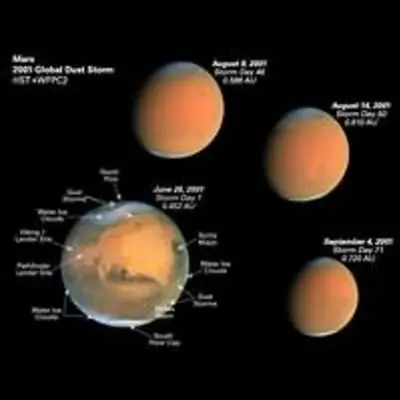
Two dramatically different faces of our Red Planet neighbor appear in these comparison images showing how a global dust storm engulfed Mars with the onset of Martian spring in the Southern Hemisphere. When NASA's Hubble Space Telescope imaged Mars in June, the seeds of the storm...
- Date
- Jan 1, 2001
- Mission
- Hubble Space Telescope
- Archive ID
- hubblesite-images-2001-31-1101-image

Two dramatically different faces of our Red Planet neighbor appear in these comparison images showing how a global dust storm engulfed Mars with the onset of Martian spring in the Southern Hemisphere. When NASA's Hubble Space Telescope imaged Mars in June, the seeds of the storm were caught brewing in the giant Hellas Basin (oval at 4 o'clock position on disk) and in another storm at the northern polar cap.
When Hubble photographed Mars in early September, the storm had already been raging across the planet for nearly two months obscuring all surface features. The fine airborne dust blocks a significant amount of sunlight from reaching the Martian surface. Because the airborne dust is absorbing this sunlight, it heats the upper atmosphere. Seasonal global Mars dust storms have been observed from telescopes for over a century, but this is the biggest storm ever seen in the past several decades.
Mars looks gibbous in the right photograph because is it 26 million miles farther from Earth than in the left photo (though the pictures have been scaled to the same angular size), and our viewing angle has changed. The left picture was taken when Mars was near its closest approach to Earth for 2001 (an event called opposition); at that point the disk of Mars was fully illuminated as seen from Earth because Mars was exactly opposite the Sun.
Both images are in natural color, taken with Hubble's Wide Field Planetary Camera 2.
Credits
NASA, James Bell (Cornell Univ.), Michael Wolff (Space Science Inst.), and The Hubble Heritage Team (STScI/AURA)Image Details
| About The Object | |
|---|---|
| Object Name | Mars |
| Object Description | Planet, Global Dust Storm |
| Distance | At the 2001 Mars opposition, the planet was approximately 43 million miles (68 million km) from Earth. |
| Dimensions | The planet has a diameter of 4,222 miles (6,794 km) at the equator. |
| About The Data | |
| Data Description | Principal Astronomers: Jun 01: J. Bell (Cornell U.), P. James (U. Toledo), M. Wolff (Space Science Institute), A. Lubenow (STScI), J. Neubert (MIT/Cornell), K. Noll, H. Bond, C. Christian, S. Crawshaw, L. Frattare, F. Hamilton, J. Lee, Z. Levay, T. Royle (Hubble Heritage Team/STScI) Aug-Sep 01: J. Bell (Cornell U.), M. Wolff (Space Science Institute), R. Morris (JSFC) |
| Instrument | HST>WFPC2 |
| Exposure Dates | June 26, 2001 (left), and September 4, 2001 (right) |
| Filters | Jun 01: 410nm, 502nm, 588nm, 631nm, 673nm, 1042nm Aug-Sep 01: 255nm, 336nm, 410nm, 502nm, 547nm, 588nm, 631nm, 673nm, 680nm, 868nm, 953nm, 1042nm |
Downloads
Source
Image and source material are credited to the official mission archive linked below.
View on NASA.gov