Hubble image archive
Gravitational Lens Arcs in Galaxy Cluster Abell 1689
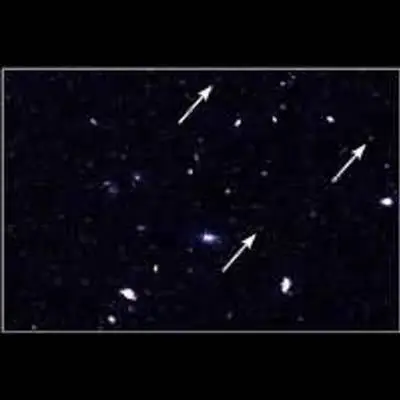
A selection of cropped images from a NASA Hubble Space Telescope Advanced Camera for Surveys view of one of the most massive galaxy clusters known, called Abell 1689. These close-ups show "lensed" images of background galaxies that have been brightened and smeared by the gravitat...
- Date
- Jan 1, 2003
- Mission
- Hubble Space Telescope
- Archive ID
- hubblesite-images-2003-01-1281-image

A selection of cropped images from a NASA Hubble Space Telescope Advanced Camera for Surveys view of one of the most massive galaxy clusters known, called Abell 1689. These close-ups show "lensed" images of background galaxies that have been brightened and smeared by the gravitational bending of light by the foreground cluster. The yellow-white objects are the cluster galaxies located 2.2 billion light-years away. The blue arcs are the distorted images of background galaxies located billions of light-years farther away than Abell 1689. The distribution of both "normal" and dark matter, and the alignment of the background galaxies determine the amount of distortion. In a perfectly aligned gravitational lens the background object would be smeared into an "Einstein ring." Instead, there are numerous ring sections or arcs corresponding to individual galaxies. Though the galaxy images are distorted, numerous structural details such as star clusters and dust lanes are magnified. These would not normally be resolved without the lensing effect of the foreground cluster. Red objects in the field may be nearby cool stars, or galaxies at great distances. Images of the same galaxies are also mirrored on either side of the cluster. These distortions yield clues to dark matter in space, and the curvature of the universe. They also beautifully demonstrate Einstein's theory of general relativity that predicted that gravity warps space. This representative color image is a composite of visible-light and near-infrared exposures taken in June 2002.
Credits
NASA, N. Benitez (JHU), T. Broadhurst (Racah Institute of Physics/The Hebrew University), H. Ford (JHU), M. Clampin (STScI), G. Hartig (STScI), G. Illingworth (UCO/Lick Observatory), the ACS Science Team and ESA;The members of the ACS science team are: H.C. Ford (JHU), G.D. Illingworth (UCO/Lick Observatory), N. Benitez (JHU), M. Clampin (STScI), G.F. Hartig (STScI), D.R. Ardila (JHU), F. Bartko (Bartko Science & Technology), J.P. Blakeslee (JHU), R.J. Bouwens (UCO/Lick Observatory), T.J. Broadhurst (Racah Institute of Physics, The Hebrew University), R.A. Brown (STScI), C.J. Burrows (STScI), E.S. Cheng (NASA-GSFC), N.J.G. Cross (JHU), P.D. Feldman (JHU), M. Franx (Leiden Observatory), D.A. Golimowski (JHU), C. Gronwall (Pennsylvania State University), L. Infante (Pontificia Universidad Catolica de Chile), R.A. Kimble (NASA-GSFC), J.E. Krist (STScI), M.P. Lesser (Steward Observatory), A.R. Martel (JHU), F. Menanteau (JHU), G.R. Meurer (JHU), G.K. Miley (Leiden Observatory), M. Postman (STScI), P. Rosati (European Southern Observatory), M. Sirianni (JHU), W.B. Sparks (STScI), H.D. Tran (JHU), Z.I. Tsvetanov (JHU), R.L. White (STScI/JHU), and W. Zheng (JHU)
Image Details
| About The Object | |
|---|---|
| Object Name | Abell 1689 |
| Object Description | Galaxy Cluster, Gravitational Lens |
| R.A. Position | 13h 11m 34.19s |
| Dec. Position | -1° 21' 56.0" |
| Constellation | Virgo |
| Distance | The distance to the lensing cluster is 2.2 billion light-years (675 megaparsecs). |
| About The Data | |
| Data Description | Principal Astronomers / ACS science team: H.C. Ford (JHU), G.D. Illingworth (UCO/Lick Observatory), N. Benitez (JHU), M. Clampin (STScI), G.F. Hartig (STScI), D.R. Ardila (JHU), F. Bartko (Bartko Science & Technology), J.P. Blakeslee (JHU), R.J. Bouwens (UCO/Lick Obs.), T.J. Broadhurst (Racah Institute of Physics, The Hebrew University), R.A. Brown (STScI), C.J. Burrows (STScI), E.S. Cheng (NASA-GSFC), N.J.G. Cross (JHU), P.D. Feldman (JHU), M. Franx (Leiden Observatory), D.A.Golimowski (JHU), C. Gronwall (PSU), L. Infante (Pontificia Universidad Catolica de Chile), R.A. Kimble (NASA GSFC), J.E. Krist (STScI), M.P. Lesser (Steward Obs.), A.R. Martel (JHU), F. Menanteau (JHU), G.R. Meurer (JHU), G.K. Miley (Leiden Obs.), M. Postman (STScI), P. Rosati (ESO), M. Sirianni (JHU), W.B. Sparks (STScI), H.D. Tran (JHU), Z.I. Tsvetanov (JHU), R.L. White (STScI/JHU), and W. Zheng (JHU) |
| Instrument | HST>ACS/WFC |
| Exposure Dates | June, 2002, Exposure Time: 13.2 hours |
| Filters | F475W (g), F625W (r), F775W (i), F850LP (z) |
Source
Image and source material are credited to the official mission archive linked below.
View on NASA.gov