Hubble image archive
Lone Black Hole Passes in Front of Star
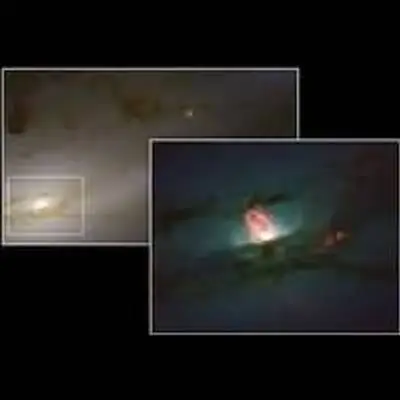
[Left] Two images of a crowded starfield as seen through a ground-based telescope show the subtle brightening of a star due to the effect of gravitational microlensing, where an invisible but massive foreground object passes in front of the star and amplifies its light. The dark...
- Date
- Jan 1, 2000
- Mission
- Hubble Space Telescope
- Archive ID
- hubblesite-images-2000-03-930-image

[Left]
Two images of a crowded starfield as seen through a ground-based telescope show the subtle brightening of a star due to the effect of gravitational microlensing, where an invisible but massive foreground object passes in front of the star and amplifies its light. The dark lensing object is estimated to be a six-solar-mass black hole that is drifting alone among the stars.
[Right]
A NASA Hubble Space Telescope image of the same field clearly resolves the lensed star and yields its true brightness. The Hubble observation was needed because the ground-based images do not tell how bright the lensed star actually was before (or after) it was lensed. The star fields where microlensing events are observed are so crowded with stars that the lensed star images are often blended together with images of unlensed stars. But with the Hubble images, astronomers can identify the lensed star and determine its normal brightness. The Hubble images were taken on June 15, 1999.
Credits
[LEFT] – NOAO, Cerro Tololo Inter-American Observatory;[Right] – NASA and Dave Bennett (University of Notre Dame, Indiana)
Image Details
| About The Object | |
|---|---|
| Object Name | MACHO-96-BLG-5 |
Downloads
Source
Image and source material are credited to the official mission archive linked below.
View on NASA.gov