Webb image archive
IC 348 (NIRCam Image)
NASA’s James Webb Space Telescope recently observed IC 348, a star-forming region just 1,000 light-years away from Earth. This is one of the largest Webb images released to t...
- Date
- Sep 15, 2026
- Observatory
- James Webb Space Telescope
- Credit
- NASA / ESA / CSA / STScI
- Archive ID
- ic-348-nircam-image-2
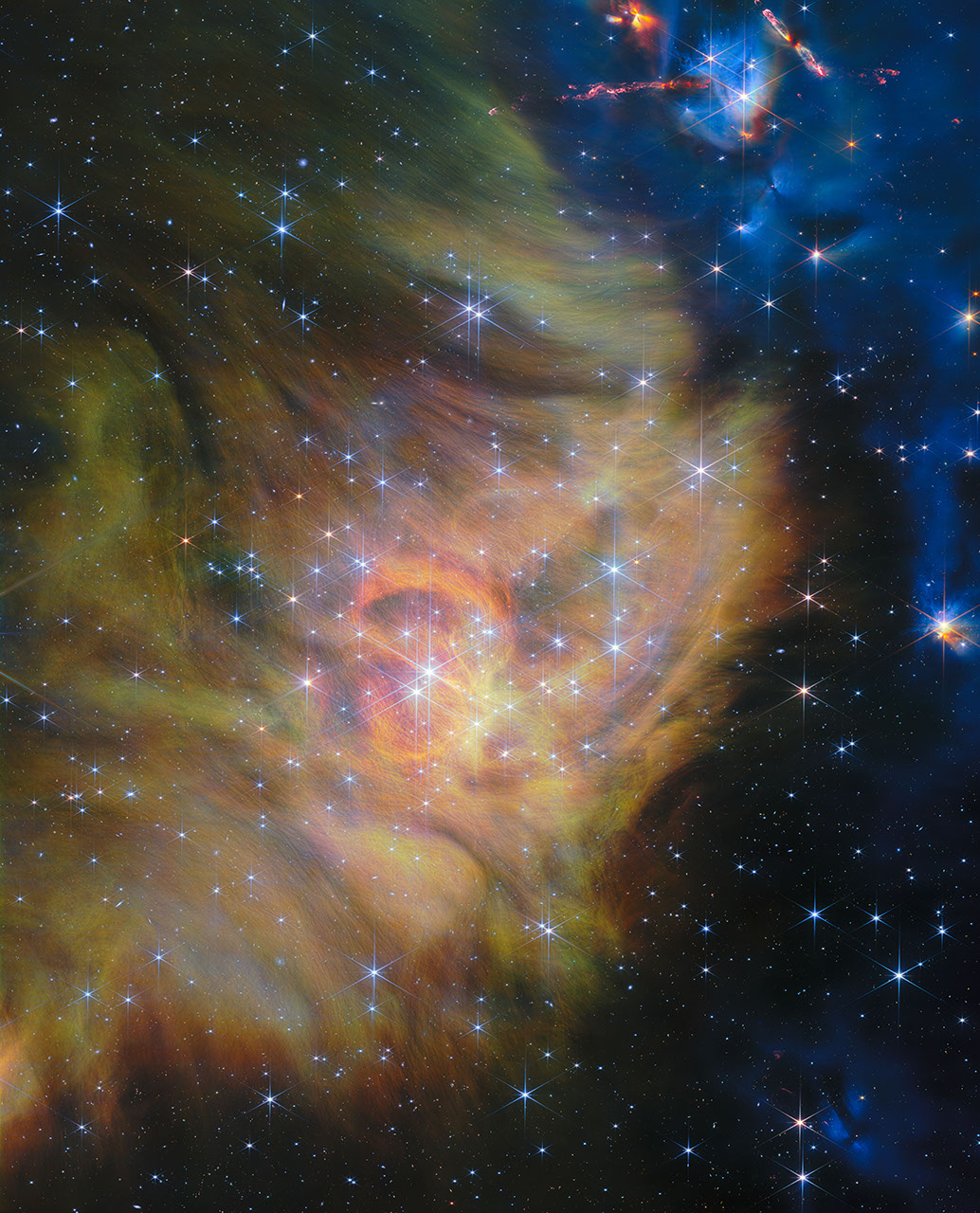
NASA’s James Webb Space Telescope recently observed IC 348, a star-forming region just 1,000 light-years away from Earth. This is one of the largest Webb images released to the public to date. This near-infrared vista of IC 348 reveals a collection of objects called brown dwarfs, which are smaller than the smallest stars.
Researchers used the unparalleled sensitivity of Webb’s NIRCam (Near-Infrared Camera) to track down the smallest brown dwarfs in IC 348, which weigh in at just twice the mass of Jupiter. These are the least massive brown dwarfs known, and their existence poses challenges to models of how stars form.
In addition to the brown dwarfs and young stars scattered across the swirling nebula, this image provides a unique perspective on a handful of protostars, which can be seen in the upper-right corner. These protostars are ejecting powerful jets that have crashed into the gas and dust surrounding them, creating luminous regions called Herbig-Haro objects.
Image Details
About the Object
| R.A. Position | 03:44:34.28 |
|---|---|
| Dec. Position | +32:09:43.10 |
| Constellation | Perseus |
| Distance | About 1,000 lightyears |
| Dimensions | This image is about 19.1 arcminutes high (.1 lightyear) |
About the Data
| Data Description | This image was created with Webb data from proposal: 4866 (K. Luuhman). |
|---|---|
| Instrument | NIRCam |
| Exposure Dates | 30 Aug 2024 |
| Filters | F162M, F182M, F360M, F444W |