Webb image archive
IC 348 Collage
This collage features a collection of insets from NASA’s James Webb Space Telescope’s image of the massive star-forming region IC 348. Each of these six panels showcase...
- Date
- Sep 15, 2026
- Observatory
- James Webb Space Telescope
- Credit
- NASA / ESA / CSA / STScI
- Archive ID
- ic-348-collage
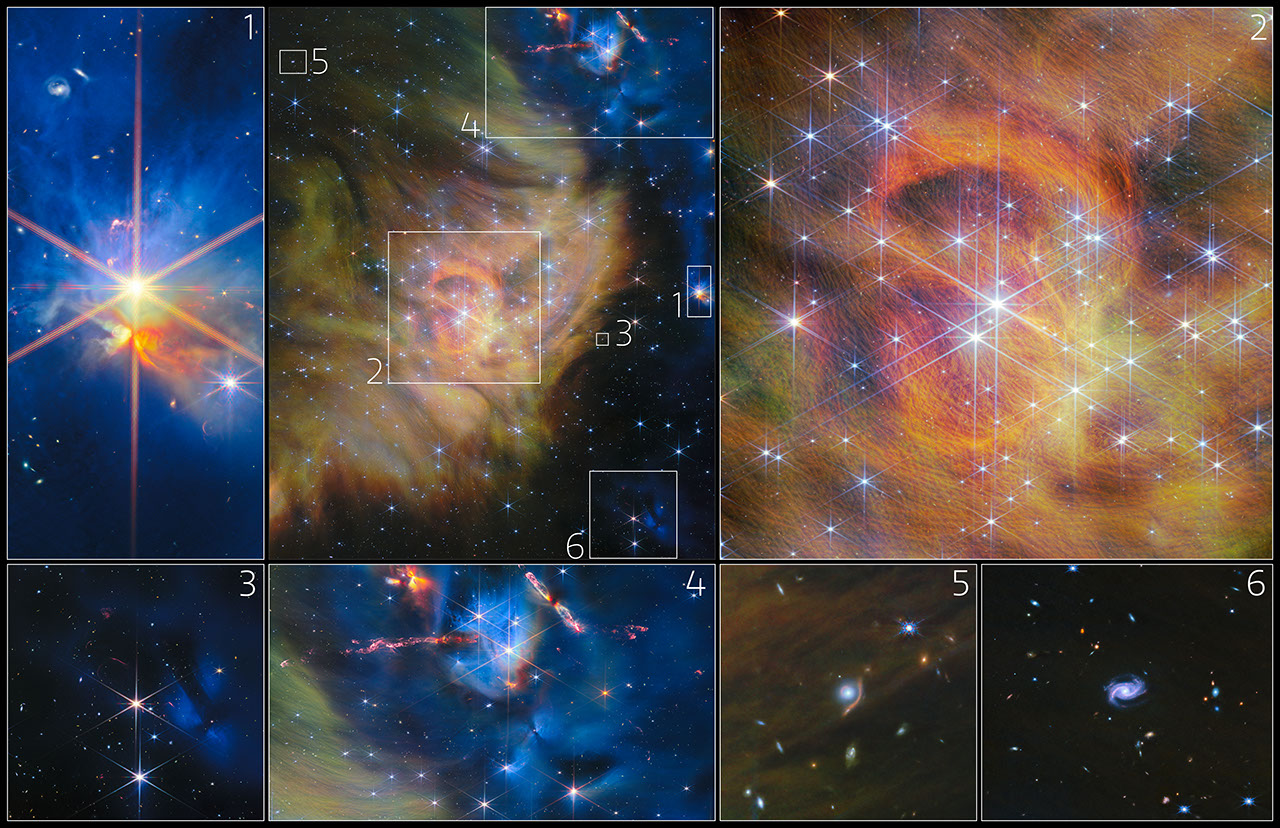
This collage features a collection of insets from NASA’s James Webb Space Telescope’s image of the massive star-forming region IC 348. Each of these six panels showcase features of interest visible throughout the field:
- Star embedded in a nebula: This small portion of the field contains two stars deeply embedded in a cloud of gas and dust. The large star’s shorter-wavelength infrared light is absorbed by the dust, leaving it brightest at longer wavelengths, which are colored orange. The same dust absorption creates the silhouettes in the image.
- Central star cluster: The center of IC 348 is dominated by wispy curtains of gas that form a large loop. Winds from the many stars sculpt the clouds of interstellar gas and dust, and the clouds reflect the light from the cluster’s stars, known as a reflection nebula.
- Stars and faint outflows: Here on the outskirts of the field, two stars shine out of clouds of gas and dust. The stars appear equally bright, but the orange one is more deeply embedded. Thin red arcs and blotches near the stars are hot, glowing shockwaves created by fast-moving outbursts from the stars.
- Herbig-Haro objects: This relatively small region near the top of the image is packed with long, glowing outflows and bold colors in the waves of gas and dust. The outflows, known as Herbig-Haro objects, are created by stellar winds or jets from protostars plowing into the thick clouds around them. No less than three objects in this area have previously been the subjects of their own images, demonstrating how rich an area of star formation this is.
- Gravitational lensing: This tiny object, at first glance appearing almost like a planet with a ring, is in fact two galaxies. The blue one is closer to us, and the orange galaxy is very far away behind it, but lined up just right. This causes the light from the orange galaxy to be bent by the gravity of the blue galaxy, creating a magnified, warped image.
- Spiral galaxies: Some of the more prominent galaxies that can be seen behind the clouds of gas and dust. While the IC 348 region is around 1,000 light-years from Earth, these galaxies are millions of light-years away, and the even smaller galaxies that appear as colored dots in the background are up to billions of light-years distant.
Image Details
About the Object
| R.A. Position | 03:44:34.28 |
|---|---|
| Dec. Position | +32:09:43.10 |
| Constellation | Perseus |
| Distance | About 1,000 lightyears |
About the Data
| Data Description | This image was created with Webb data from proposal: 4866 (K. Luuhman). |
|---|---|
| Instrument | NIRCam |
| Exposure Dates | 30 Aug 2024 |
| Filters | F162M, F182M, F360M, F444W |
Download
- Collage-Full-Res-For-Print
- Collage
- Collage
- Crop1-Full-Res-For-Print
- Crop1-Full-Res-For-Display
- Crop1
- Crop1
- Crop2-Full-Res-For-Print
- Crop2-Full-Res-For-Display
- Crop2
- Crop2
- Crop3-Full-Res-For-Print
- Crop3-Full-Res-For-Display
- Crop3
- Crop3
- Crop4-Full-Res-For-Print
- Crop4-Full-Res-For-Display
- Crop4
- Crop4
- Crop5-Full-Res-For-Print
- Crop5-Full-Res-For-Display
- Crop5
- Crop6-Full-Res-For-Print
- Crop6-Full-Res-For-Display
- Crop6
- Crop6