Hubble image archive
Stellar Fireworks Accompany Antennae Galaxy Collision
This Hubble Space Telescope image provides a detailed look at a brilliant "fireworks show" at the center of a collision between two galaxies. Hubble has uncovered over 1,000 bright, young star clusters bursting to life as a result of the head-on wreck.[Left] A ground-based telesc...
- Date
- Jan 1, 1997
- Mission
- Hubble Space Telescope
- Archive ID
- hubblesite-images-1997-34-530-image
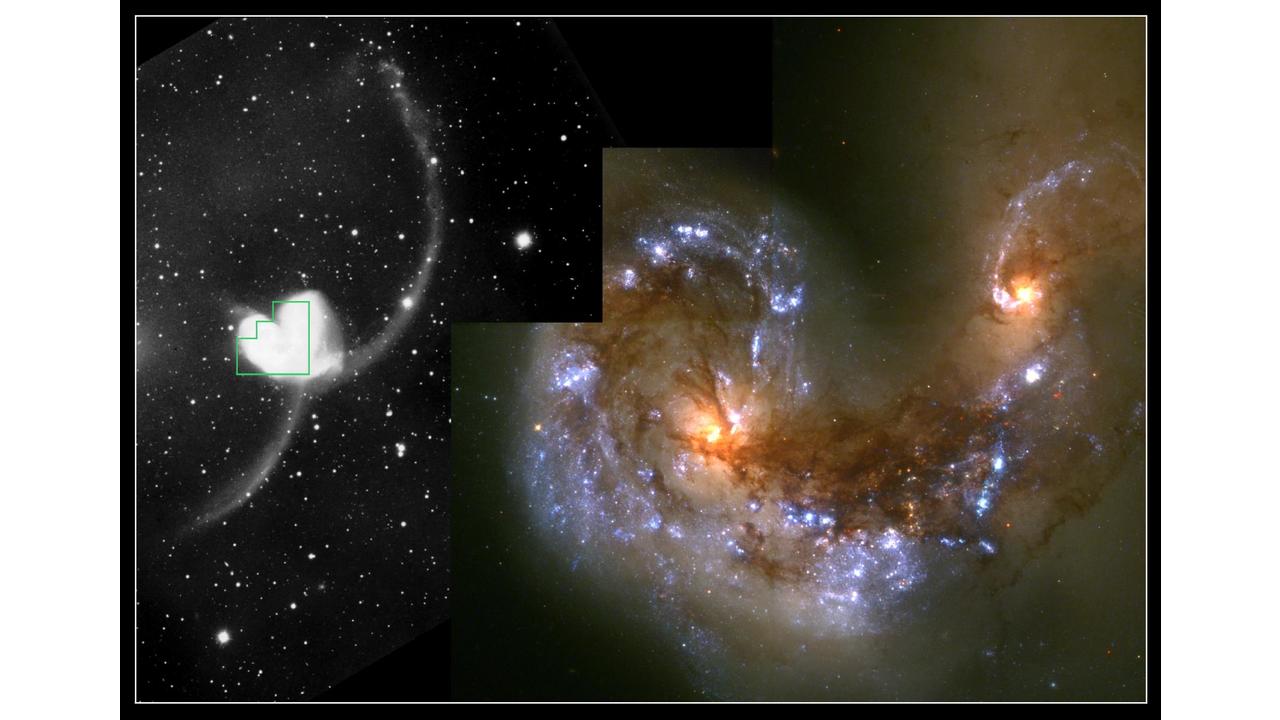
This Hubble Space Telescope image provides a detailed look at a brilliant "fireworks show" at the center of a collision between two galaxies. Hubble has uncovered over 1,000 bright, young star clusters bursting to life as a result of the head-on wreck.
[Left]
A ground-based telescopic view of the Antennae galaxies (known formally as NGC 4038/4039) - so named because a pair of long tails of luminous matter, formed by the gravitational tidal forces of their encounter, resembles an insect's antennae. The galaxies are located 63 million light-years away in the southern constellation Corvus.
[Right]
The respective cores of the twin galaxies are the orange blobs, left and right of image center, crisscrossed by filaments of dark dust. A wide band of chaotic dust, called the overlap region, stretches between the cores of the two galaxies. The sweeping spiral- like patterns, traced by bright blue star clusters, shows the result of a firestorm of star birth activity which was triggered by the collision.
This natural-color image is a composite of four separately filtered images taken with the Wide Field Planetary Camera 2 (WFPC2), on January 20, 1996. Resolution is 15 light-years per pixel (picture element).
Credits
Brad Whitmore (STScI) and NASAImage Details
| About The Object | |
|---|---|
| Object Name | NGC 4038/4039, Antennae |
Downloads
Source
Image and source material are credited to the official mission archive linked below.
View on NASA.gov